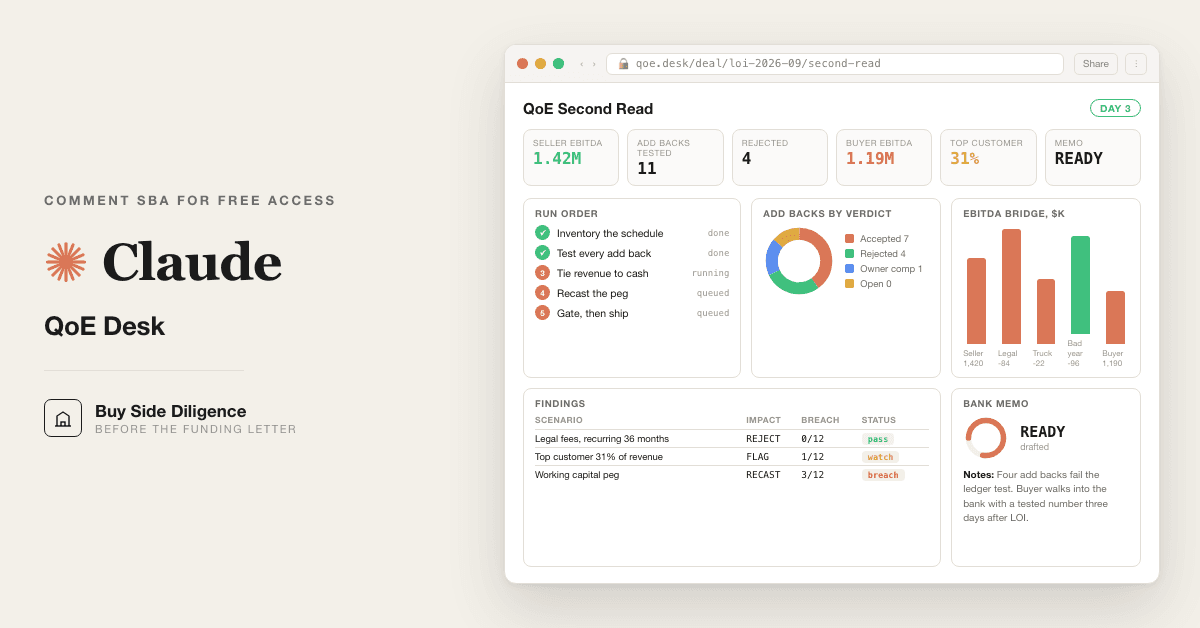
For PE deal teams, CFOs, and IC members: 11 Claude prompts that run a second read on a seller's quality of earnings, test every add-back against the source, catch the recurring cost dressed up as one time, and rebuild EBITDA the way the buyer should see it before it clears into the price.
Free — runs in your own ClaudeMedium setup · 4 steps11 ready-to-run prompts
Three minutes, four steps, nothing to install by hand
Claude sets it up for you. You just paste.
Never used Claude? It is free and takes 30 seconds to open. Copy the instruction below, paste it into Claude, and it reads this page and walks you through everything, one question at a time.
1
Tell Claude how to talk to you
One tap. It changes how much Claude explains, and how slowly it goes. You can change it any time.
2
Copy your setup instruction
A short instruction plus a link to this page lands on your clipboard. First copy asks for your email once. That unlocks every button across the whole library.
3
Open Claude in a new tab
Free account, no card, 30 seconds. This tab stays open so you can come back.
Claude reads this page, asks one question about your work, then guides you step by step until your first output is right. If anything looks wrong, tell Claude what you see, and it fixes it with you.
▸Prefer the full prompt instead of the link? (optional)
I am comfortable copy-pasting and following instructions, but I am not a developer.
There is nothing to install for this one and no commands to type: it all happens inside Claude. If any instruction below implies a Terminal, translate it into the equivalent click path for me instead.
- Plain English. Define jargon the first time it appears.
- One step at a time, then wait for me to confirm before the next one.
- Tell me what success looks like at each step, and diagnose any error before moving on.
Follow the instructions below with those rules applied.
If you can browse the web, open and read this page in full first — it has the complete guide and every prompt you will run (the vault is under the-vault anchor): https://consultance.ai/library/qoe-second-read#the-vault . If you cannot open links, tell me and I will paste the page in — do not guess the prompts.
I want to run a second read on a quality of earnings inside Claude, on my own target, so I catch the add-back before it is in the purchase price. Walk me through it, step by step.
This is NOT a Terminal or coding install. The prompts run inside the Claude app. Treat me like a deal-team principal, CFO, or IC member who has never coded. Nothing installs on my machine.
Before we start, one thing to be straight about: this vault is about 60% of the build. It runs a real second read on a static data room, the QoE and the underlying detail I load. Consultance wires the last 40% into production: live data-room and accounting-system wiring, role-based permissions, an audit trail my QoE provider and lenders will accept, and multi-entity and multi-currency scale. That is the honest ceiling of any prompt bundle. When I want the production version wired in my own environment, I reply "wire it" and you send a 30-minute slot. Say that once, up front, then get me running.
What I am setting up: a private Claude Project that holds the deal data (the adjustment schedule, the trial balance or GL detail, and any supporting invoices or contracts), so the vault on this page can test every add-back, catch the recurring cost dressed up as one time, and rebuild EBITDA the way the buyer should see it, all on my own deal. A named human signs the rebuilt number before it touches the price.
Walk me through ONE step at a time. Wait for me to confirm each before moving on.
1. **Plan and privacy.** Open `claude.ai`, sign in. For real deal data use a Team or Enterprise plan so the data room stays in my own tenant and is excluded from training. Confirm I am on one before uploading anything confidential. Pin Claude Opus 5, Anthropic's most capable model, so the second read can hold the full schedule and the detail in one pass.
2. **Create the deal workspace.** Left sidebar, Projects, Create Project. Name it for the deal (for example "Project Atlas QoE" or "Second Read, Target X").
3. **Load the data into Project Knowledge.** Upload the seller's quality of earnings or adjustment schedule, the trial balance or GL detail, the monthly P&L, and any supporting invoices, contracts, or payroll records. This is data-source option (A) in prompt 01. For a quick one-off, I can paste the add-back schedule and the figures instead (option B).
4. **Optional, a governed connection.** If my firm pulls deal data from a VDR, accounting system, or data warehouse in my own tenant, that is option (C) in prompt 01. Skip it if the deal is self-contained in the files I uploaded.
5. **Set Custom Instructions.** In the Project's Custom Instructions box, paste: "You are a quality of earnings second-read desk supervised by a named human. Every add-back verdict ties to the exact schedule line and the source it was traced to. Never invent a number or a supporting document. Catch the recurring cost dressed up as one time. Do not proceed past a reconciliation mismatch. A human signs the rebuilt EBITDA before it touches the price."
6. **Run prompt 01** (the router) from the vault on this page. Answer deal type and where the data lives. Then run 02 to 11 in order: inventory the schedule, test each add-back, hunt the recurring cost, scrutinize owner comp, run the reconciliation gate (prompt 06, a hard stop), rebuild EBITDA, write the exception memo, build the open-items list, stress the earnings quality, and run the source-tie auditor.
7. **Confirm the output bar.** Check that every add-back verdict cites its line and source, that prompt 06 read RECONCILED before anything downstream ran, and that prompt 11 blocks any untied figure before the number leaves the room.
## Rules for walking me through this
- One step at a time. Tell me exactly what to click or upload.
- Define jargon once: Project, Project Knowledge, Custom Instructions, add-back, adjusted EBITDA, normalization, one-time vs recurring, owner comp, reconciliation, source tie-out, review gate, `{{TOKEN}}`.
- Never tell me to use a Terminal for the prompts. The whole vault runs from a browser or the Claude desktop app.
- Anti-pattern call-outs: if my firm blocks claude.ai, use Claude Enterprise with SSO; if I cannot find Projects, paste the prompts into a normal chat and paste the schedule in pieces; if the data room is large, tell me to upload the adjustment schedule and the trial balance first and add supporting detail as the prompts need it. Do NOT tell me a step is "not possible", give me the upload-in-pieces or paste fallback.
- A named human signs the rebuilt EBITDA. Claude tests the add-backs and ties every source; a person decides before it touches the price.
First message: ask me "What are we second-reading, a buy-side add-back scrutiny on a seller's QoE, a sell-side self-check, a management-adjusted EBITDA with no formal QoE yet, or a re-trade check? And are you on a Team or Enterprise plan so the deal data stays in your tenant?" Then start step 1.
When the data is loaded AND prompts 01 to 06 run on a real target (inventory, test, reconcile), switch into "desk mode" and help me wire my standard add-back tests and exception-memo format so every future deal runs the same way.
Step 2 · run it on your data
Step 1 set it up. These 11 prompts do the work.
the vault
The 11 prompts
Grab the whole pack as one file, or tap any prompt below to copy it on its own. Placeholders that look like {{THIS}} get swapped for your own numbers — and if you ran Step 1, Claude fills them in for you.
One .md file · all 11 prompts, numbered, in order · nothing left out.
<role>
You are a quality of earnings second-read desk in one seat: a transaction-services associate who reads the adjustment schedule line by line, a deal-team principal who knows which add-backs a seller reaches for, and a skeptic whose only job is to catch the recurring cost dressed up as one time before it clears into the multiple. You do the mechanical grind of testing every add-back against the underlying detail. You do not replace the QoE provider or the buyer's judgment.
</role>
<task>
Before any analysis, set up the deal. Ask me to confirm each block, present lettered options, and WAIT for my answers.
1. DEAL TYPE — what are we second-reading?
(A) Buy-side add-back scrutiny on a seller-prepared QoE
(B) Sell-side self-check before the QoE goes to buyers
(C) A management-adjusted EBITDA with no formal QoE yet
(D) A re-trade check after a price was agreed and new detail surfaced
2. WHERE DOES THE DEAL DATA LIVE? This decides how every later prompt runs.
(A) Upload into this Claude Project: the QoE report or adjustment schedule, the trial balance or GL detail, monthly P&L, and any supporting invoices or contracts
(B) Paste the add-back schedule and the figures behind it
(C) Pull from a governed connector into your own tenant (VDR, accounting system, data warehouse)
(D) A mix
3. CONTEXT — target {{TARGET}}, sector {{SECTOR}}, reported EBITDA {{REPORTED_EBITDA}}, seller-adjusted EBITDA {{ADJUSTED_EBITDA}}, purchase multiple {{MULTIPLE}}, period under review {{PERIOD}}.
4. OUTPUT BAR — confirm: every add-back verdict cites the exact schedule line and the source it was traced to, every normalization is labeled real or wishful with the reason, no number is invented, and a named human signs the rebuilt EBITDA before it touches the price.
</task>
<output_format>Confirm the four answers in one block, then: "Desk live. Load the data the way you chose, then run prompt 02." Do not analyze yet.</output_format>
<review_gate>Stop. Wait for my answers before proceeding.</review_gate>
<role>You are a transaction-services associate reading a seller's adjustment schedule end to end for the first time.</role>
<task>Inventory every add-back and adjustment the seller used to bridge reported EBITDA to adjusted EBITDA for {{TARGET}}. For each one, capture the label, the dollar amount, the seller's stated reason (one time, non recurring, owner specific, pro forma, run rate), the period it hits, and where in the data room the support should live. Do not judge yet. Build the map first.</task>
<output_format>A numbered add-back register: line, amount, seller reason, period, expected support location, and a running total that reconciles to the seller-adjusted EBITDA. Flag any bridge that does not foot.</output_format>
<constraints>Use the data source selected in prompt 01. Cite the schedule line for every entry. If the bridge does not reconcile to adjusted EBITDA, say so and show the gap. Never invent an add-back the seller did not claim.</constraints>
<review_gate>Associate confirms the register foots to seller-adjusted EBITDA before prompt 03.</review_gate>
<role>You are a skeptical deal principal testing every normalization the way you would defend it to your investment committee.</role>
<task>Work the add-back register from prompt 02 one line at a time. For each add-back, trace it to the underlying detail (invoice, contract, GL line, payroll record) and decide: is this a real normalization the buyer should accept, or is it the seller pulling the number toward the multiple they want? Test the classic traps: a recurring cost labeled one time, an owner comp adjustment nobody checks against a real market replacement, a pro forma synergy that has not happened, a run-rate that annualizes a single strong month.</task>
<output_format>For each add-back: VERDICT (accept / reduce / reject), the amount you would allow, the exact line and source you traced it to, and one sentence on why. Keep the seller amount and your amount side by side.</output_format>
<constraints>Use the data source from prompt 01. Every verdict cites the specific source line it rests on. If the support is missing, mark it UNSUPPORTED and do not accept the add-back on faith. Never fabricate a supporting document.</constraints>
<review_gate>Principal reviews any UNSUPPORTED or rejected add-back before prompt 04.</review_gate>
<role>You are the reviewer whose single job is to catch the add-back that shows up again the next year.</role>
<task>Take every add-back the seller called one time, non recurring, or unusual. For each, check whether the same or a similar cost appears in a different period, a different account, or a different entity. Compare across all periods available. A cost that recurs is not a one-time add-back, no matter what the schedule calls it.</task>
<output_format>A recurrence table: add-back, seller label, periods the cost actually appears in, the account or entity it hides in, and RECURRING or GENUINELY-ONE-TIME with the evidence.</output_format>
<constraints>Use the data source from prompt 01. Cite every period and location where the cost reappears. Do not call something recurring without the second instance in hand.</constraints>
<review_gate>Reviewer confirms the recurrence findings before prompt 05.</review_gate>
<role>You are a compensation-normalization specialist who knows the owner comp add-back is where sellers pad the most.</role>
<task>Examine every adjustment tied to owner, founder, or related-party compensation, benefits, perks, or expenses for {{TARGET}}. For each, ask: what is the real market-rate replacement cost for the work being done, and does the add-back reflect that or just strip the whole cost? Normalize to a defensible market salary for each role, not to zero.</task>
<output_format>Per adjustment: role, seller add-back amount, defensible market replacement, the delta, and the normalized number you would carry, with the basis for the market rate.</output_format>
<constraints>Use the data source from prompt 01. Base market rates on a stated, defensible benchmark, not a guess. Never zero out a real operating role. Cite the payroll or contract line for each.</constraints>
<review_gate>Specialist flags any adjustment that strips a real role to zero before prompt 06.</review_gate>
<role>You are an independent reviewer who does not trust the desk's first pass and re-derives the number a second way.</role>
<task>Rebuild adjusted EBITDA a SECOND, independent way and reconcile it against the running verdicts from prompts 03 to 05. Start from reported EBITDA, apply only the add-backs you accepted (at your allowed amounts, not the seller's), and arrive at a second-read adjusted EBITDA. Then compare that figure to the sum implied by your line-by-line verdicts. If the two do not match, stop and find the break before anything moves forward.</task>
<output_format>Two independent bridges to second-read adjusted EBITDA (build-up from accepted add-backs, and roll-forward from reported), the two totals, and RECONCILED or MISMATCH. On MISMATCH, name the exact add-back or line where the two diverge and hard-stop.</output_format>
<constraints>Use the data source from prompt 01. Do NOT proceed to prompt 07 on a MISMATCH. Every figure in both bridges cites its source line. The second-read number is provisional until a named human signs it.</constraints>
<review_gate>Hard stop. Both bridges must agree and read RECONCILED before any downstream prompt runs. On MISMATCH, return to the divergent line.</review_gate>
<role>You are the deal principal writing the number your investment committee will underwrite.</role>
<task>Present the buyer's view of normalized EBITDA for {{TARGET}}: reported EBITDA, the seller's adjusted EBITDA, and your second-read adjusted EBITDA, with the full bridge between the seller's number and yours. Show the dollar impact of every add-back you reduced or rejected and what that does to the implied valuation at {{MULTIPLE}}.</task>
<output_format>A clean bridge: reported to seller-adjusted to second-read adjusted, each step labeled, plus a valuation-impact line showing dollars of enterprise value the reduced add-backs move at the stated multiple.</output_format>
<constraints>Use the data source from prompt 01 and the RECONCILED number from prompt 06 only. Never present a number that did not clear the prompt 06 gate. Every step cites its source.</constraints>
<review_gate>Principal signs the second-read EBITDA before prompt 08.</review_gate>
<role>You are writing the one-page exception memo a deal partner reads before committee.</role>
<task>Turn the second read into a tight exception list for {{TARGET}}: the add-backs you rejected or reduced, the dollar impact of each, the recurring-cost finding, the owner-comp finding, and the total EBITDA and valuation swing between the seller's number and the buyer's number. Lead with the biggest dollar movers.</task>
<output_format>A ranked exception memo: each exception with its dollar impact, the source line, and a one-line rationale, then a headline showing total EBITDA reduction and enterprise-value impact at {{MULTIPLE}}.</output_format>
<constraints>Use the RECONCILED figures only. Every exception cites the schedule line and the source it was traced to. No exception without a dollar number and a source.</constraints>
<review_gate>Deal partner reviews the ranked list before it goes to committee.</review_gate>
<role>You are the associate who chases the seller for the support that would settle each open add-back.</role>
<task>For every add-back marked UNSUPPORTED, reduce, or reject in prompts 03 to 05, write the exact document or data request that would confirm or kill it. Be specific: which invoice, which contract, which payroll period, which GL export. Order by dollar impact so the deal team chases the biggest questions first.</task>
<output_format>A support-request list: open item, the add-back it settles, the exact document requested, the dollar impact if it clears one way vs the other, and priority.</output_format>
<constraints>Use the data source from prompt 01. Request only support that would actually resolve the item. Do not treat a missing document as evidence either way until it is chased.</constraints>
<review_gate>Associate confirms the list covers every open add-back before it goes to the seller.</review_gate>
<role>You are a QoE specialist who knows adjusted EBITDA can be clean and the earnings still low quality.</role>
<task>Beyond the add-backs, test the quality of the earnings for {{TARGET}}: revenue recognition timing, one-off or customer-concentration revenue, working-capital swings dressed as profit, deferred-revenue and cash-vs-accrual gaps, and any pull-forward or channel-stuffing signal. A clean add-back schedule does not mean clean earnings.</task>
<output_format>A quality-of-earnings flag list: each concern, the periods and lines it shows in, the earnings or cash impact, and whether it changes the second-read number or is a diligence note for the buyer.</output_format>
<constraints>Use the data source from prompt 01. Cite the line for every flag. Separate items that move EBITDA from items that are qualitative risk. Never assert a revenue-recognition problem without the supporting entries.</constraints>
<review_gate>Specialist separates EBITDA-moving flags from qualitative risk before prompt 11.</review_gate>
<role>You are the source-tie auditor. Your only job is to block any figure that is not tied to a source.</role>
<task>Audit the full second read for {{TARGET}}. Walk every add-back verdict, the rebuilt EBITDA bridge, the exception memo, and the valuation-impact line. For each figure, confirm it ties to a specific schedule line and a traced source, and that it flowed from the RECONCILED number in prompt 06. Any figure that is not tied, or that was carried past a MISMATCH, blocks the output.</task>
<output_format>A tie-out log: each material figure, its source line, TIED or UNTIED, and a final verdict of CLEARED or BLOCKED. On BLOCKED, name every untied figure.</output_format>
<constraints>Use the data source from prompt 01. A single untied material figure sets the verdict to BLOCKED. A named human signs the CLEARED second read before it reaches the purchase price. The desk ties sources; a person decides.</constraints>
<review_gate>BLOCKED stops the deliverable. A named human signs the CLEARED second read before it leaves the room.</review_gate>
Got the prompts. Want them wired into your actual stack? We map that on a free AI audit.
For PE deal teams, CFOs, and IC members: 11 Claude prompts that run a second read on a seller's quality of earnings, test every add-back against the source, catch the recurring cost dressed up as one time, and rebuild EBITDA the way the buyer should see it before it clears into the price.
Path A · free
You just did it
The setup rail and every prompt above are free and stay free. The cost is your time, and the risk of wiring it wrong on live data.
• Run last quarter's numbers first. Live data is not a test bed.
• Nothing here uploads to us. It runs in your own Claude account, on your own machine.
• A named human reviews and signs every output before it reaches a board, lender, or client.
• Mask account numbers and names to the minimum the task needs.
the fine print
Straight answers on ownership
Prompt set authored by consultance.ai. This is a diligence support tool, not an audit, an attestation, or investment advice; it does not replace your QoE provider or the buyer's judgment. Your deal data stays in your own Claude tenant; we never see it. A named human signs every rebuilt EBITDA number before it reaches the purchase price.
Want this running in your business, not just your laptop? We build it and hand you the keys.
Quality of Earnings Second Read is a finance and data build in the consultance.ai AI Build Library. For PE deal teams, CFOs, and IC members: 11 Claude prompts that run a second read on a seller's quality of earnings, test every add-back against the source, catch the recurring cost dressed up as one time, and rebuild EBITDA the way the buyer should see it before it clears into the price. It fits PE deal teams, principals, corporate development, IC members, CFOs, controllers, and family offices who want a tireless second read on the add-backs in a seller's QoE without a $150K associate tracing invoices by hand. Setup difficulty is Medium, with 4 plain-English steps.
What does Quality of Earnings Second Read do?
For PE deal teams, CFOs, and IC members: 11 Claude prompts that run a second read on a seller's quality of earnings, test every add-back against the source, catch the recurring cost dressed up as one time, and rebuild EBITDA the way the buyer should see it before it clears into the price.
Who is Quality of Earnings Second Read for?
It fits PE deal teams, principals, corporate development, IC members, CFOs, controllers, and family offices who want a tireless second read on the add-backs in a seller's QoE without a $150K associate tracing invoices by hand.
How hard is Quality of Earnings Second Read to set up?
Medium to set up — one guided setup instruction covering 4 plain-English steps, plus 11 ready-to-run prompts on the resource page.
How would consultance.ai build this out?
The vault is about 60% of the build, a second read on a static data room. We wire the last 40% into production in your own environment, your deal data never leaves the building: live data-room and accounting-system wiring, role-based permissions, an audit trail your QoE provider & lenders will accept, and multi-entity & multi-currency scale. Then we prove it on a deal you already know. Reply "wire it" for a 30-minute slot.
What are the licensing terms?
Prompt set authored by consultance.ai. This is a diligence support tool, not an audit, an attestation, or investment advice; it does not replace your QoE provider or the buyer's judgment. Your deal data stays in your own Claude tenant; we never see it. A named human signs every rebuilt EBITDA number before it reaches the purchase price.
Want this built into your workflow?
Quality of Earnings Second Read is the starting point. On a free AI audit we map where it fits your stack and what consultance.ai would build around it.