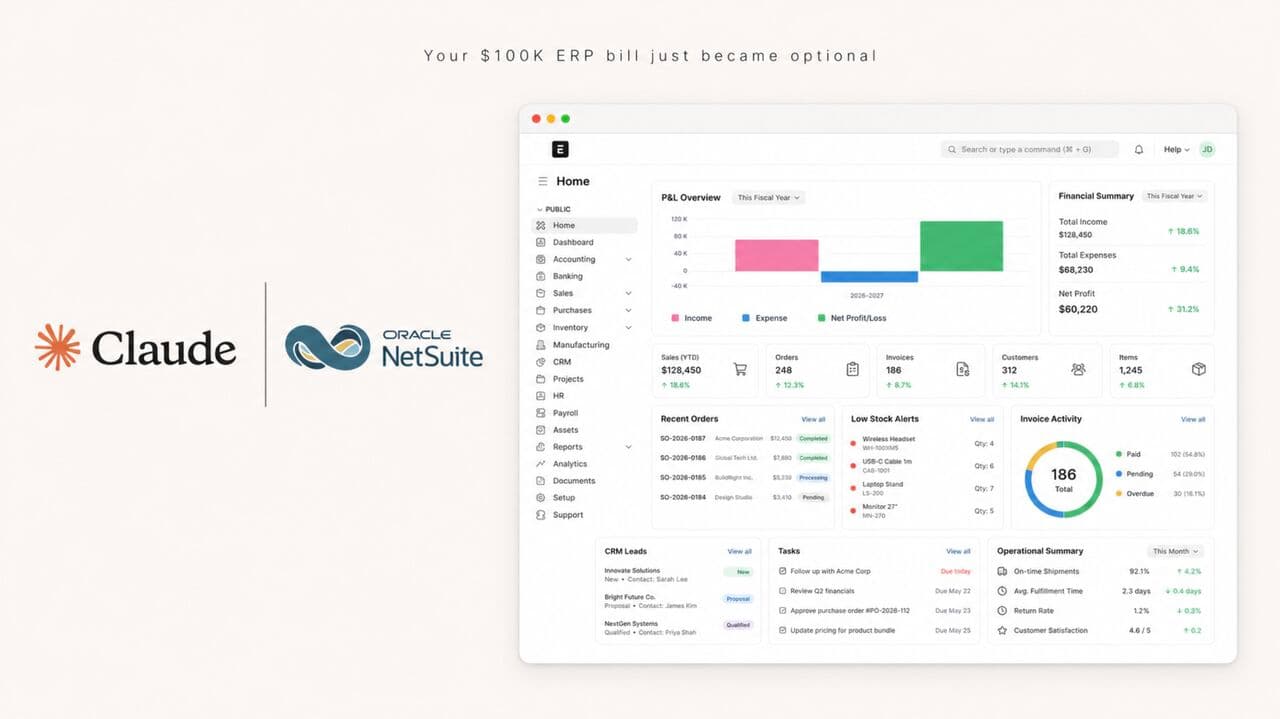
ERPNext open-source ERP
Goodbye NetSuite. Free open-source software that replaced the $100,000/year ERP your competitors are still paying for.
Who this is for
Best for SMBs paying five figures a year for ERP, operators consolidating spreadsheets, and finance teams that want one source of truth.
We would run the full migration: data import, custom dashboards, workflow automation, role design, and an operator playbook so the team is not lost on day one.
Setup steps
Use the official Frappe and ERPNext install path (Docker or bench) on a clean server.
Create a sandbox company first and import a small slice of real data to test workflows.
Map your existing chart of accounts, inventory items, and CRM fields before switching anyone over.
Add backups, role-based permissions, and audit logs before connecting live operations.
Before you connect live data
- • Run dummy data first. Real client data is not a test bed.
- • API keys never go in a public repo. Use env vars and a secrets manager.
- • Add logging, access control, monitoring, and a rollback path before launch.
- • Read the license. Forking a repo without checking is how lawsuits start.
Credit the original author
ERPNext is GPLv3. Respect the license, attribution, and contribution rules when you customise or redistribute.
We list this as a guide, not as our build, unless we are actively maintaining a fork.
Paste this into Claude. It will install it for you.
Open Claude or Claude Code. Paste the prompt below. It will ask you a few setup questions, then walk you through every step adapted to your machine.
You are helping me install and run **ERPNext open-source ERP** on my machine. Repo / link: https://github.com/frappe/erpnext Category: Business operations What it does: Goodbye NetSuite. Free open-source software that replaced the $100,000/year ERP your competitors are still paying for. Difficulty: Technical Setup steps from the public guide: 1. Use the official Frappe and ERPNext install path (Docker or bench) on a clean server. 2. Create a sandbox company first and import a small slice of real data to test workflows. 3. Map your existing chart of accounts, inventory items, and CRM fields before switching anyone over. 4. Add backups, role-based permissions, and audit logs before connecting live operations. Before writing or running anything, ask me these in ONE batch and wait for my reply: 1. What operating system am I on? (macOS / Windows / Linux) 2. Do I already have Docker installed and running? 3. Do I have Git installed? 4. Do I have Node or Python installed, and what versions? 5. Which model provider keys do I have available right now? (Anthropic, OpenAI, Gemini, OpenRouter, none) 6. Where do I want this installed on disk? 7. Is this just to test locally, or am I planning to connect it to live business data soon? 8. Anything sensitive (real client data, payment access, mailbox access) it should NOT touch on this machine? After I answer, walk me through each setup step adapted to my environment. Stop after each step, show me the command, and wait for me to confirm it ran before moving on. If a step fails, diagnose the actual error before suggesting the next move. Do not connect this to live business data until I explicitly say go.
Want it wired into your business instead of your laptop?
A repo on your machine is a starting point. The work that pays back is connecting it to the CRM, inbox, payments, and team processes you already run. That is the part we ship.