
Works where your team works
It reads from the spreadsheets, inboxes, client records and systems you already use. Nobody has to learn a new tool.
We find the recurring workflow that costs your team the most hours in finance, operations or client service, and build it inside the tools you already use. Every number links back to its source, human review stays at each approval step, and you keep the code.
Book an auditIt reads from the spreadsheets, inboxes, client records and systems you already use. Nobody has to learn a new tool.
Reconciliations, reports, research and replies, drafted to your format and routed to the right person for review.
Every answer points to the page it came from, and people only see sources they already have access to.
The process
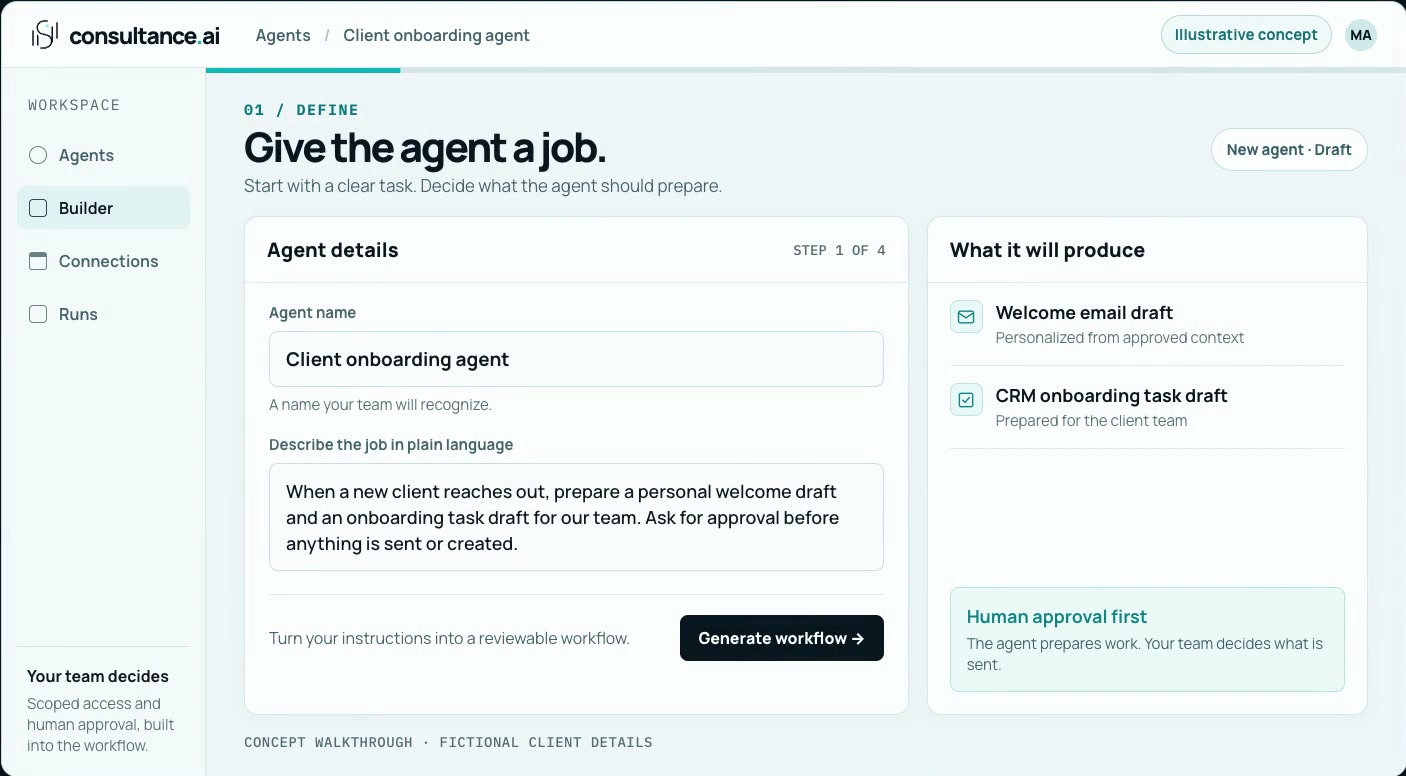
Each step ends with a decision, and you can stop after any of them. Start with one workflow, then add the next once the first is running.
Book an auditWe map one recurring workflow with you: the tools involved, where the hours go and the review controls it needs. You leave with a written audit and no obligation to continue.
If it is worth building, you get the scope in writing: the workflow, the sources it connects, the controls and the price.
We run a scoped proof of concept on representative data first, so you see real output before anyone commits to a production build.
The system runs in your cloud tenancy or on your own machines. Access, approved model providers, retention and review steps are agreed before work starts.
You receive the code, the prompts and the operating documentation. Ongoing maintenance and accuracy checks are scoped with you.
Transaction materials, valuation, and buyer coverage.
Reconciliation, close, and reporting with the evidence attached.
A connected view of diligence and portfolio performance.
Underwriting, covenant review, and portfolio monitoring.
Connect lead intake, property knowledge, and client follow-through.
Bring statements, maintenance, and guest communications into one workflow.
Source-grounded research, document review, and client reporting.
Turn policies, precedent, and research into usable evidence.
Document intake, customer operations, and reporting built around your team.
Private deployment, source visibility, and human review at the points where judgement matters.
Built around your data boundary.
Sources beside the decision. People at the approval point.
Your workflow, knowledge and code stay yours.
Diligence moved from months to weeks. The numbers stayed connected to the evidence, and the system stayed inside the fund's environment.
Research & practice
How to build a covenant tracking system for private credit: model each agreement's definitions, recompute every test from source, and route exceptions to a reviewer.
Read the insightResearch & practice
Bloomberg Terminal alternative open source options in 2026: Fincept Terminal and OpenBB's Open Data Platform compared on license, data, cost and current status.
Read the insightResearch & practice
Fincept Terminal review for 2026: what the open source C++ finance terminal does, what the AGPL license means, what Enterprise costs, and who should use it.
Read the insightA few practical answers
Consultance provides AI consulting and implementation for finance and operations teams. We build source-grounded deal desks, reconciliation, financial close, reporting, and private knowledge systems around your existing tools and review process.
Investment banks, private equity and private credit funds, CFO teams, family offices, real estate firms, property managers, and professional-services teams with recurring document, knowledge, or operational work.
The system connects your sources, permissions, integrations, and approval steps to a defined workflow. Your team receives the code, prompts, and operating documentation, with maintenance and accuracy support scoped alongside the production build.
Deployment is scoped around your data boundary, whether that is your cloud tenancy or a local environment. Access permissions, approved model providers, retention, and review controls are agreed before implementation. Confidential documents are not required for the initial audit call.
Material figures and claims stay linked to their source evidence. Verification and exception handling identify what needs attention, and your team retains responsibility for judgment and final approval before an output enters a decision or operating process.
A founder-led audit maps one recurring workflow, its cost, and the controls it needs. A scoped proof of concept tests representative data before a production build. Timing depends on data condition, integrations, and deployment requirements.
Newsletter
One short note when a new build ships: what it does, who it is for, and how to run it in your own Claude.
Free. One email a week at most. Unsubscribe in one click.