Finance and data
Free Bloomberg Terminal Alternative
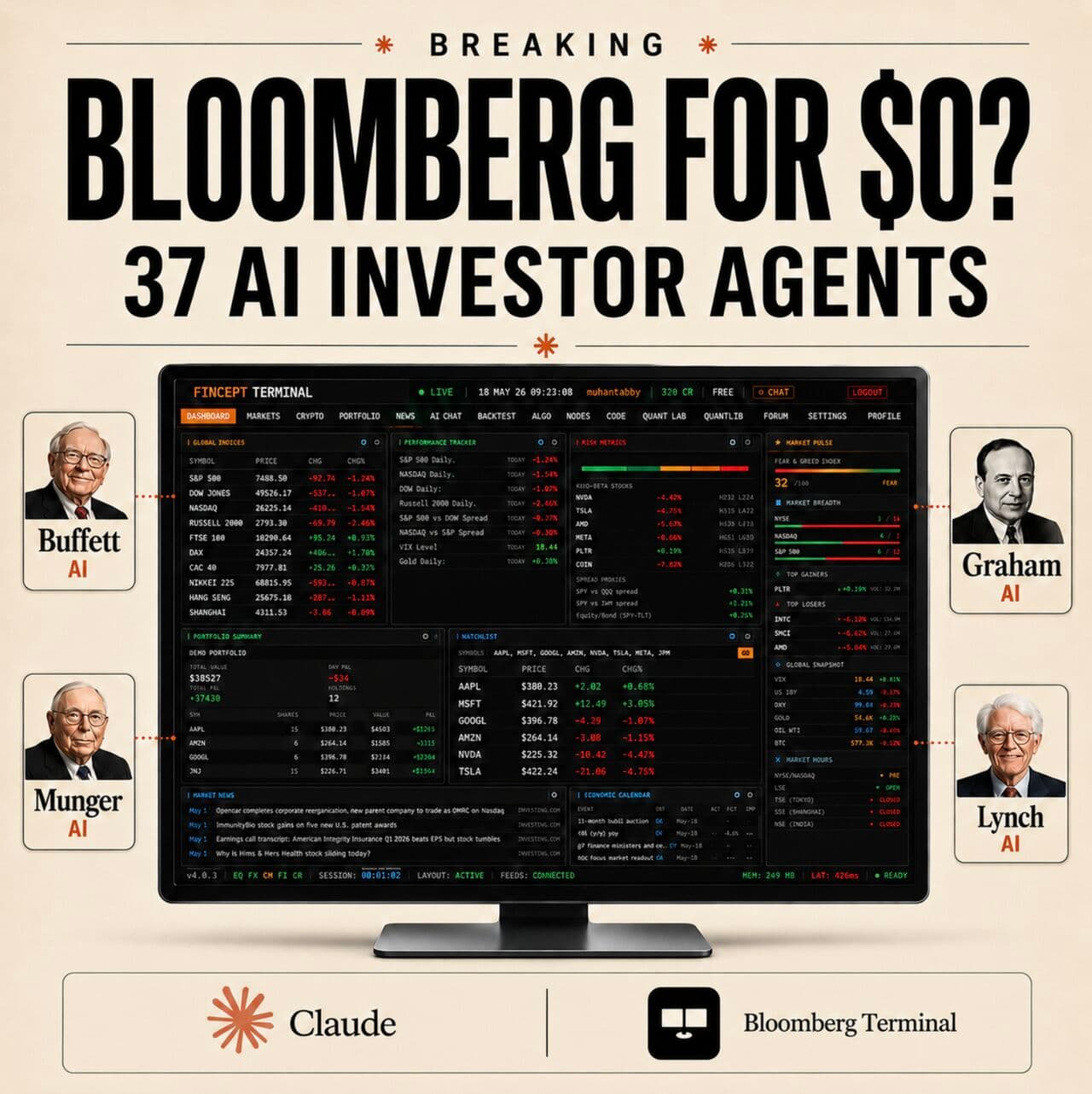
A free, open source terminal for analysts and finance founders. Track live stocks, bonds, and crypto, and run 37 AI agents, without paying for a Bloomberg seat.
 Finance and data
Start with the guided setup
Follow the setup below in your own workspace. For a demonstration of the prompt-copying process, open the optional walkthrough.
Watch the setup walkthroughStep 1 · setup
Three minutes, four steps, nothing to install by hand
Claude sets it up for you. You just paste.
Never used Claude? It is free and takes 30 seconds to open. Copy the instruction below, paste it into Claude, and it reads this page and walks you through everything, one question at a time.
Tell Claude how to talk to you
One tap. It changes how much Claude explains, and how slowly it goes. You can change it any time.
Copy your setup instruction
A short instruction plus a link to this page lands on your clipboard. First copy asks for your email once. That unlocks every button across the whole library.
Open Claude in a new tab
Free account, no card, 30 seconds. This tab stays open so you can come back.
Open claude.aiPaste, send, and answer one question
Claude reads this page, asks which computer you are on, then guides you step by step until it works. If anything errors, tell Claude what you see, and it fixes it with you.
▸Prefer the full prompt instead of the link? (optional)
Click to copy
Install Free Bloomberg Terminal Alternative on my computer. Walk me through it.

Repo: https://github.com/Fincept-Corporation/FinceptTerminal
What it does: A free, open source terminal for analysts and finance founders. Track live stocks, bonds, and crypto, and run 37 AI agents, without paying for a Bloomberg seat.

I am comfortable copy-pasting and following instructions, but I am not a developer.

Rules:
- Plain English. Define jargon the first time it appears (repo, env var, port, dependency).
- One step at a time. Exact command in a code block. Tell me which app to paste it into (Terminal on Mac, PowerShell on Windows).
- One sentence per command explaining what it does and what success looks like.
- After each command, wait. I will tell you the output before you move on.
- If a tool is missing (git, node, docker, python), give me the one-line install for my OS first.
- If something errors, diagnose before the next step. Do not skip.

First message: ask only "What is your operating system, macOS, Windows, or Linux?" Then start step 1.

Reference steps from the public guide (adapt to my OS, do not just paste them at me):
1. Install the official Fincept Terminal release for your platform.
2. Connect data feeds one at a time and validate each before enabling the next.
3. Run the AI agents on read-only data first; do not connect trading accounts during testing.
4. Add monitoring and access control before letting the team use it for live decisions.

Stop when the app opens and I confirm it works.
Source repo
https://github.com/Fincept-Corporation/FinceptTerminal The code is public and free. The setup instruction above installs and wires it for you. You never need to open this link.
A Bloomberg seat is rent on data. A terminal you own is a download.
A Bloomberg seat is a recurring bill for access to the same markets everyone else sees. Fincept gives you live stocks, bonds, crypto, and 37 AI agents that pick like Buffett, Munger, and Lynch — a real research stack without the seat charge.
Path A · free
Run the build independently
The setup rail and every prompt above are free and stay free. The cost is your time, and the risk of wiring it wrong on live data.
Back to the promptsPath B · done with you
Connect it to your operation
We deliver a deployed Fincept workspace: curated data feeds validated, a custom agent roster built for your firm, and a clean dashboard your non-technical partners can actually read. Bloomberg-grade research, no Bloomberg seat, no trial-and-error on live feeds.
Book a build calldata safety
Before you use live numbers
- • Run last quarter's numbers first. Live data is not a test bed.
- • Nothing here uploads to us. It runs in your own Claude account, on your own machine.
- • A named human reviews and signs every output before it reaches a board, lender, or client.
- • Wiring the open-source piece to real systems? Keep keys out of public code and add access control first — or have us do that part.
the fine print
Credit the original author
Verify the current repository license and respect each connected data provider's terms.
Read this far? You want the research stack without the seat. Let us deploy Fincept — you own the workspace and every feed.
Want this wired into your stack instead of running it yourself? That is our AI deal desk and finance automation service.
Newsletter
New builds, as they ship
One short note when a new build ships: what it does, who it is for, and how to run it in your own Claude.
Free. One email a week at most. Unsubscribe in one click.
More like this
Related builds
Ramp Claude Connector Setup Guide
For controllers and finance ops teams on Ramp: Claude setup steps plus 12 read only prompts for spend baseline, close readiness, accruals and flux. Replaces the manual Ramp export to Excel.
Claude and NetSuite Setup Guide
For controllers, CFOs and FP&A leads on NetSuite: the setup steps for Oracle's Claude connector plus 12 read only prompts for close, receivables, payables and cash.
QuickBooks and Claude Setup Guide
For owners, controllers and fractional CFOs on QuickBooks Online: connect Intuit's QuickBooks connector to Claude, then run 11 prompts for cash, receivables, month end, billing drafts and a tie out.
Share with your workflow owner.
Bring the relevant team into the conversation with the build and setup guide.
in one line
What is Free Bloomberg Terminal Alternative?
Free Bloomberg Terminal Alternative is a finance and data build in the consultance.ai AI Build Library. A free, open source terminal for analysts and finance founders. Track live stocks, bonds, and crypto, and run 37 AI agents, without paying for a Bloomberg seat. It fits analysts, finance founders, family offices, and operators who want a real research stack without paying for a Bloomberg seat. Setup difficulty is Technical, with 4 plain-English steps.
What does Free Bloomberg Terminal Alternative do?
A free, open source terminal for analysts and finance founders. Track live stocks, bonds, and crypto, and run 37 AI agents, without paying for a Bloomberg seat.
Who is Free Bloomberg Terminal Alternative for?
It fits analysts, finance founders, family offices, and operators who want a real research stack without paying for a Bloomberg seat.
How hard is Free Bloomberg Terminal Alternative to set up?
Technical to set up — one guided setup instruction covering 4 plain-English steps on the resource page.
How would consultance.ai build this out?
We would deliver a deployed Fincept workspace with curated data feeds, a custom agent roster for the firm, and a clean dashboard for non-technical partners.
What are the licensing terms?
Verify the current repository license and respect each connected data provider's terms.
Connect this build to your workflow.
Discuss how Free Bloomberg Terminal Alternative fits your systems, controls, and team. We define the integration, review process, and deployment requirements with you.
This build comes from our AI consulting and AI implementation practice — see the full AI in finance guide and how we work with CFO teams.