Finance and data
The FP&A Agent Stack
For CFOs, controllers, and FP&A leads: the map of ten agent desks that run the planning cycle inside your own Claude, from the overnight analyst roster and the rolling forecast to variance, cash, close, reporting, the board pack, and the statement rec, plus the order to install them in.
Start with the guided setup
Follow the setup below in your own workspace. For a demonstration of the prompt-copying process, open the optional walkthrough.
Watch the setup walkthroughStep 1 · setup
Three minutes, four steps, nothing to install by hand
Claude sets it up for you. You just paste.
Never used Claude? It is free and takes 30 seconds to open. Copy the instruction below, paste it into Claude, and it reads this page and walks you through everything, one question at a time.
Tell Claude how to talk to you
One tap. It changes how much Claude explains, and how slowly it goes. You can change it any time.
Copy your setup instruction
A short instruction plus a link to this page lands on your clipboard. First copy asks for your email once. That unlocks every button across the whole library.
Open Claude in a new tab
Free account, no card, 30 seconds. This tab stays open so you can come back.
Open claude.aiPaste, send, and answer one question
Claude reads this page, asks one question about your work, then guides you step by step until your first output is right. If anything looks wrong, tell Claude what you see, and it fixes it with you.
▸Prefer the full prompt instead of the link? (optional)
Click to copy
Set me up with The FP&A Agent Stack in my own Claude. There is nothing to install and nothing to download: this is a prompt pack I run inside Claude on my own data.

Guide: https://consultance.ai/library/fpna-stack
What it does: For CFOs, controllers, and FP&A leads: the map of ten agent desks that run the planning cycle inside your own Claude, from the overnight analyst roster and the rolling forecast to variance, cash, close, reporting, the board pack, and the statement rec, plus the order to install them in.

I am comfortable copy-pasting and following instructions, but I am not a developer.

Rules:
- Plain English. Define jargon the first time it appears (repo, env var, port, dependency).
- One step at a time. Exact command in a code block. Tell me which app to paste it into (Terminal on Mac, PowerShell on Windows).
- One sentence per command explaining what it does and what success looks like.
- After each command, wait. I will tell you the output before you move on.
- If a tool is missing (git, node, docker, python), give me the one-line install for my OS first.
- If something errors, diagnose before the next step. Do not skip.

First message: ask only "What is your operating system, macOS, Windows, or Linux?" Then start step 1.

Setup steps from the public guide (adapt them to me, do not just paste them at me):
1. Start with the Forecast Desk the day the close lands. A stack installed against a board date survives, a stack installed between cycles does not.
2. Add the Variance Desk immediately after. The board pack inherits whatever the variance rebuild gets wrong.
3. Add Close and Cash next. They are the recurring grind with a fixed date attached, so the payoff lands this month.
4. Pin Claude Opus 5 for forecast, variance, and the board narrative. The Board Pack Desk goes last, it packages what the other nine produce. The Overnight Analyst roster is the pattern teacher, not a replacement for the named signer.

Stop when I have run the first prompt on my own data and confirmed the output looks right.
From a working build to an operating system.
For CFOs, controllers, and FP&A leads: the map of ten agent desks that run the planning cycle inside your own Claude, from the overnight analyst roster and the rolling forecast to variance, cash, close, reporting, the board pack, and the statement rec, plus the order to install them in.
Path A · free
Run the build independently
The setup rail and every prompt above are free and stay free. The cost is your time, and the risk of wiring it wrong on live data.
Back to the promptsPath B · done with you
Connect it to your operation
The desks are ten separate guides you run by hand. Consultance stands the stack up as one workspace in your own environment: the desks your finance calendar actually needs, your ERP and planning files connected under governed access, review gates where your audit committee requires them, and the whole thing handed over so your team owns it. Reply "wire it" for a 30-minute slot.
Book a build calldata safety
Before you use live numbers
- • Run last quarter's numbers first. Live data is not a test bed.
- • Nothing here uploads to us. It runs in your own Claude account, on your own machine.
- • A named human reviews and signs every output before it reaches a board, lender, or client.
- • Mask account numbers and names to the minimum the task needs.
the fine print
Straight answers on ownership
Prompt sets authored by consultance.ai. Each desk carries its own honest ceiling, stated on its own page. The desks do not talk to each other, you run them by hand and carry output between them yourself. This is decision support, not accounting advice, and no desk replaces your controller, your auditor, or a control your audit committee expects to see. A named human signs every output before it reaches a board, a lender, or an auditor. Your data stays in your own Claude tenant, we never see it.
Bring this workflow into your operation.
Want this wired into your stack instead of running it yourself? That is our AI deal desk and finance automation service.
Newsletter
New builds, as they ship
One short note when a new build ships: what it does, who it is for, and how to run it in your own Claude.
Free. One email a week at most. Unsubscribe in one click.
What is in this stack
The 10 desks, each free
 Finance and data
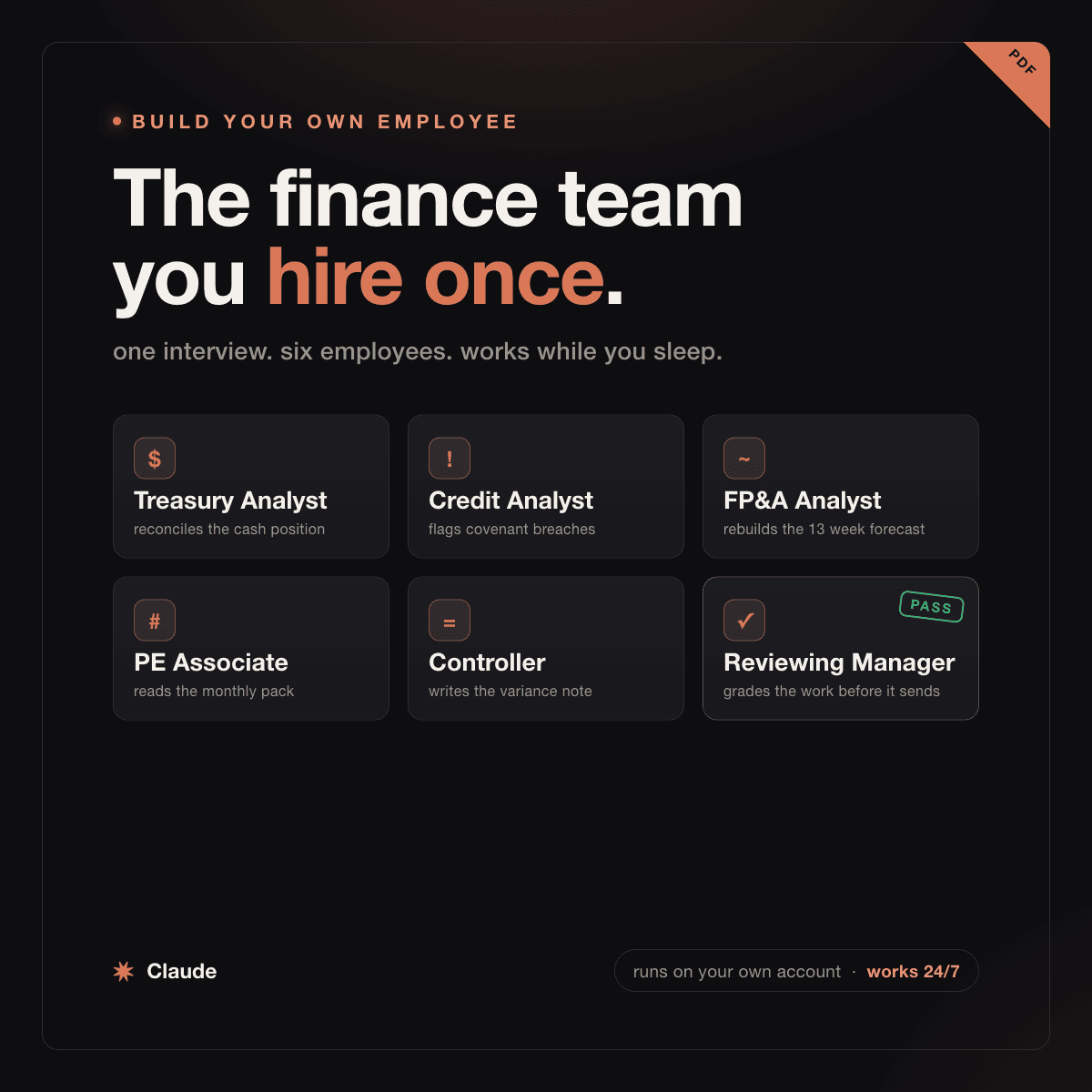
Seven Finance Agents That Run Overnight
For CFOs, family offices and PE deal teams: 11 Claude prompts that stand up seven finance analysts as scheduled agents on your own account, an ad hoc ledger analyst that answers a board question with the source cell, plus treasury, covenant, 13 week cash, portfolio, variance and board prep seats, plus a reviewing manager that independently re-derives their numbers and blocks anything that fails.
FP&A Rolling Forecast Engine
For CFOs, controllers, and PE portfolio finance leaders: rebuild the rolling forecast off your actuals the day the close lands, explain every variance to plan, and write the board commentary inside your own Claude. A free FP&A workflow and an alternative to Anaplan.
Board Variance Bridge Second Read
For CFOs, controllers, and PE portfolio finance leads: 11 Claude prompts that run a second read on your board variance bridge, split the revenue miss into price, volume, and mix, catch the reclass that quietly moved the number, and write the one line of commentary a CFO would sign, all inside the workbook you already send up.
 Finance and data
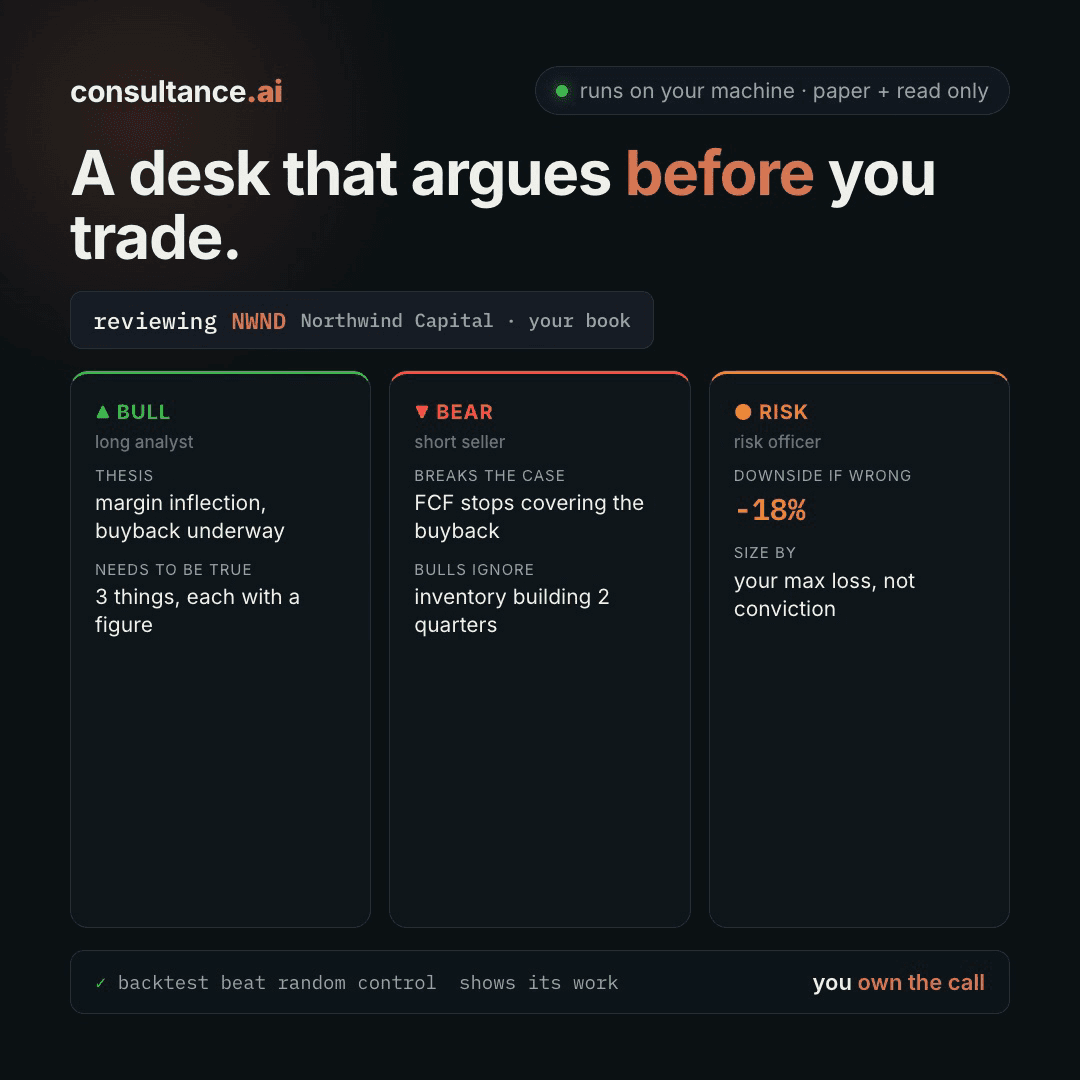
CFO 13 Week Cash Forecast Kit
For CFOs and controllers: put a second pair of eyes on the 13 week cash forecast one analyst built. Rebuild it from the ledger, back test it, and find the covenant breach date, inside your own Claude.
CFO AI Close Kit
For CFOs and controllers: run the monthly close in your own Claude, connect your own Gamma account via Claude, and ship a board pack from five exports with a gate that blocks packs it cannot tie.
 Finance and data
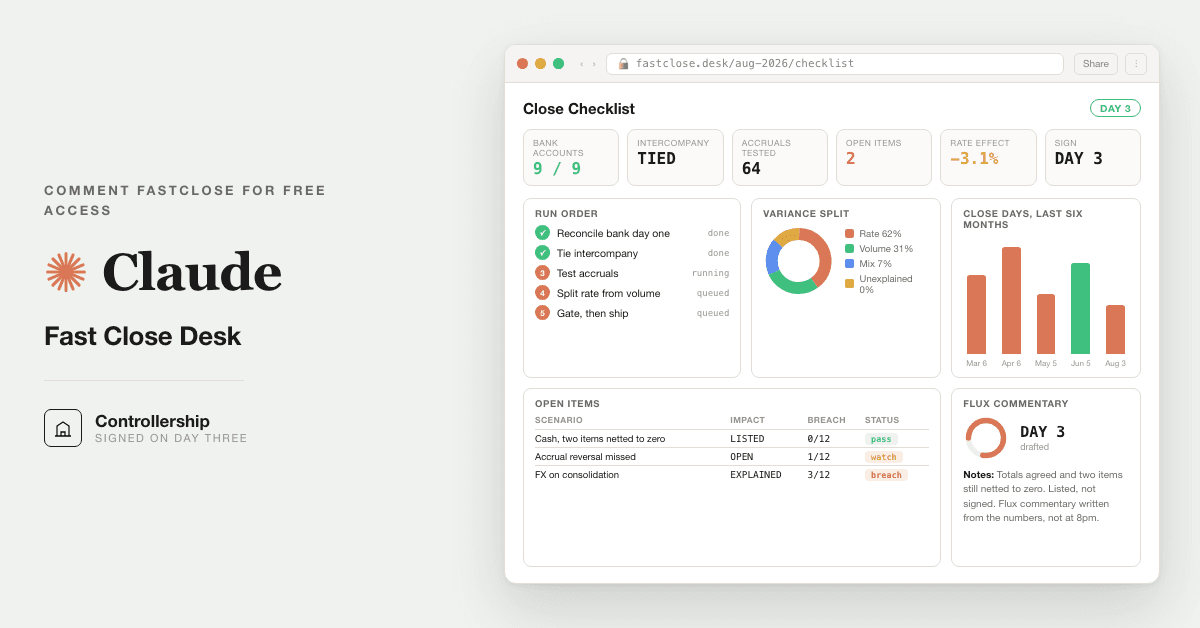
Cut Your Month End Close to One Day
For CFOs and controllers whose close runs six or seven days: 11 prompts that match the bank feed, book the accruals with the working shown, chase every variance to the journal line, and trace every entry to its source, so the close drops to a day and the board can audit it line by line.
Month-End Close Automation Pack
Prompts for controllers and CFOs to run the month-end financial close in Claude: reconcile accounts, post accruals, write flux commentary, and ship the board close package in days, not 10 to 12.
Financial Statement Preparation Pack
For finance directors and controllers preparing statutory accounts by hand: 14 Claude prompts that map the trial balance, draft the notes, build the cash flow statement, and run a checker that refuses to release a set that does not balance.
Investment committee deck prompts
14 Claude prompts that build an investment committee or board deck, from the argument spine to the Q&A prep. For PE deal teams, CFOs, and family office principals.
Statement Matching and Reconciliation
For CFOs, controllers, and fund accountants: 10 prompts plus an offline extractor that match scanned bank, custodian, and brokerage statements to your ledger in seconds and return only the breaks, on your own machine. An alternative to BlackLine.
From independent build to integrated workflow
What you have
The free version above. It runs this read on a file you paste in, in your own Claude. Yours to keep.
What we install
The same read, wired into your cfo and back office stack, running the second a report lands. Nothing to upload, no new login.
See the installed versionShare with your workflow owner.
Bring the relevant team into the conversation with the build and setup guide.
in one line
What is The FP&A Agent Stack?
The FP&A Agent Stack is a finance and data build in the consultance.ai AI Build Library. For CFOs, controllers, and FP&A leads: the map of ten agent desks that run the planning cycle inside your own Claude, from the overnight analyst roster and the rolling forecast to variance, cash, close, reporting, the board pack, and the statement rec, plus the order to install them in. It fits CFOs, controllers, FP&A managers, and PE portfolio finance leads who have seen the individual packs and want one map of which desk to install first instead of buying another planning platform and still writing the board note by hand. Setup difficulty is Easy, with 4 plain-English steps.
What does The FP&A Agent Stack do?
For CFOs, controllers, and FP&A leads: the map of ten agent desks that run the planning cycle inside your own Claude, from the overnight analyst roster and the rolling forecast to variance, cash, close, reporting, the board pack, and the statement rec, plus the order to install them in.
Who is The FP&A Agent Stack for?
It fits CFOs, controllers, FP&A managers, and PE portfolio finance leads who have seen the individual packs and want one map of which desk to install first instead of buying another planning platform and still writing the board note by hand.
How hard is The FP&A Agent Stack to set up?
Easy to set up — one guided setup instruction covering 4 plain-English steps on the resource page.
How would consultance.ai build this out?
The desks are ten separate guides you run by hand. Consultance stands the stack up as one workspace in your own environment: the desks your finance calendar actually needs, your ERP and planning files connected under governed access, review gates where your audit committee requires them, and the whole thing handed over so your team owns it. Reply "wire it" for a 30-minute slot.
What are the licensing terms?
Prompt sets authored by consultance.ai. Each desk carries its own honest ceiling, stated on its own page. The desks do not talk to each other, you run them by hand and carry output between them yourself. This is decision support, not accounting advice, and no desk replaces your controller, your auditor, or a control your audit committee expects to see. A named human signs every output before it reaches a board, a lender, or an auditor. Your data stays in your own Claude tenant, we never see it.
Connect this build to your workflow.
Discuss how The FP&A Agent Stack fits your systems, controls, and team. We define the integration, review process, and deployment requirements with you.
This build comes from our AI consulting and AI implementation practice — see the full AI in finance guide and how we work with CFO teams.