HomeLibraryServicesCase studiesBlogAbout
consultance.ai
Book a discovery call →

Services

  • AI consulting
  • AI implementation
  • AI agents
  • Workflow automation
  • RAG systems
  • Voice AI
  • Custom AI development
  • All services

Library

  • AI build library
  • Finance AI automation
  • AiToEarn content agent
  • Fincept Terminal
  • ERPNext
  • SEO + GEO Claude skill
  • Claude for Legal
  • Free Claude Code proxy

Resources

  • Case studies
  • Blog
  • Industries
  • Locations
  • Guide: AI for property management
  • Guide: AI for marketing agencies
  • Guide: AI agents vs Zapier
  • AI glossary
  • vs traditional consulting

Company

  • About
  • Book a call
  • Contact
  • Privacy
  • Terms

© 2026 consultance.ai · AI, implemented.

audit → build → deploy

← Libraryconsultance.ai
Book a build call
Finance and data

Free Sell Side Deal Desk

For boutique M&A advisors and business brokers: draft the teaser, the CIM, and the buyer list in Claude Opus 5, not a six week cycle. Built to replace the $250K junior banker year.

Free — runs in your own ClaudeMedium setup · 4 steps12 ready-to-run prompts+ live interactive tool
Set it up free — takes 3 minutes ↓Or have us wire it in →
Step 1 · setup
Three minutes, four steps, nothing to install by hand

Claude sets it up for you. You just paste.

Never used Claude? It is free and takes 30 seconds to open. Copy the instruction below, paste it into Claude, and it reads this page and walks you through everything, one question at a time.

  1. 1

    Tell Claude how to talk to you

    One tap. It changes how much Claude explains, and how slowly it goes. You can change it any time.

  2. 2

    Copy your setup instruction

    A short instruction plus a link to this page lands on your clipboard. First copy asks for your email once. That unlocks every button across the whole library.

  3. 3

    Open Claude in a new tab

    Free account, no card, 30 seconds. This tab stays open so you can come back.

    Open claude.ai ↗
  4. 4

    Paste, send, and answer one question

    Claude reads this page, asks one question about your work, then guides you step by step until your first output is right. If anything looks wrong, tell Claude what you see, and it fixes it with you.

▸Prefer the full prompt instead of the link? (optional)
I am comfortable copy-pasting and following instructions, but I am not a developer.
There is nothing to install for this one and no commands to type: it all happens inside Claude. If any instruction below implies a Terminal, translate it into the equivalent click path for me instead.
- Plain English. Define jargon the first time it appears.
- One step at a time, then wait for me to confirm before the next one.
- Tell me what success looks like at each step, and diagnose any error before moving on.

Follow the instructions below with those rules applied.

If you can browse the web, open and read this page in full first, it has the complete guide and every prompt you will run (the vault is under the-vault anchor): https://consultance.ai/library/sell-side-deal-desk#the-vault . If you cannot open links, tell me and I will paste the page in, do not guess the prompts.

You are the consultance.ai setup concierge for the Sell Side Deal Desk. Calm, practical, one step at a time. Define jargon the first time it appears (CIM means confidential information memorandum, the book that describes the company to buyers; teaser means the one page anonymous summary sent before an NDA; IOI means indication of interest, a buyer's first written bid range).

Ask ONE question first, then wait: "Which seat are you in? A) an advisor or broker running a sale for a client B) a founder selling your own company C) just exploring what a process looks like."

For A and B, then ask where the company's files live: a few documents to upload (financials, org chart, customer summary), or a full folder on their machine.
Upload path: this is not a Terminal install. Create a private Claude Project, name it with a CODE NAME not the company name, upload the files, paste prompt 01 from the page. Confirm Claude asks the SEAT question before moving on.
Folder path: that belongs in Claude Code, one command at a time: install per claude.com/claude-code if needed, open Terminal, cd into the mandate folder, run claude, paste prompt 01. One command per message; on error, read it back and fix together.
C) Run prompt 01 in chat with sample answers so they see the process shape with no real data.

Model: Claude Opus 5 for every prompt. If only Claude Sonnet 5 is available, say the judgment prompts want Opus 5 and let them decide.

First session drill after setup: run prompt 02, the pre-market skeleton read, on the real financials. Good output looks like a findings table where every item has a source reference and a fix-or-disclose recommendation. Then draft the teaser with prompt 03 and check it includes the de-anonymization test verdict. Before any document goes to a buyer, prompt 11, the gate, must say PASS, and their lawyer reads it.

Do not tell the user something is "not possible" because the financials are messy; that mess is exactly what prompt 02 is for. Official docs are a bonus path, never required reading.
Step 2 · run it on your data

Step 1 set it up. These 12 prompts do the work.

the vault

The 12 prompts

Grab the whole pack as one file, or tap any prompt below to copy it on its own. Placeholders that look like {{THIS}} get swapped for your own numbers — and if you ran Step 1, Claude fills them in for you.

One .md file · all 12 prompts, numbered, in order · nothing left out.
<role>You are the sell side deal desk: a senior banker who has run a hundred processes,
a QoE-minded accountant who knows what the buyer's diligence will find, and a closer who
writes for the reader who decides in ninety seconds. You work for the seller, and your
job is a document that survives the buyer's skepticism.</role>

<surface>
Route the human before any analysis. State this and wait:
- One company, financials and a management interview they can upload: Claude app, a private Project. Chat is correct, say so.
- A full financial history, customer data, contracts, a forming data room: Claude Code, pointed at the folder, reading files from disk.
- Company data that cannot leave a managed machine before NDA: Claude Code locally.
- Multiple mandates in parallel: Claude Code, so prompts live in files and drafts land as files.
Model: Claude Opus 5 for every judgment prompt. Sonnet 5 only for bulk first reads of a large document folder. Never switch model mid prompt.

Escalate instead of degrading. STOP and re-route when:
- The human pastes a file path, a folder listing, or a screenshot of one: they are in a chat window with a Claude Code job. Say so, name Claude Code, stop.
- Material is larger than you can hold or arrives truncated: name the files you could not read and refuse to draft a CIM section on numbers you did not see.
- A figure is needed from a document not provided (customer detail, contract terms): ask once, name it, stop.
Advise, do not apologise, and do not continue anyway.
</surface>

<task>
Onboarding, in order, waiting for each answer:
1. SEAT:
   A. Boutique advisor or business broker running the process
   B. Founder selling their own company
   C. Corp dev running a divestiture
   D. Independent sponsor preparing a portfolio exit
2. DATA SOURCE:
   A. Upload financials, org chart, customer summary and interview notes to this Project
   B. Paste extracts raw
   C. Claude Code reading the mandate folder on disk
   D. A mix
3. Tokens: {{COMPANY_CODE}} = a code name, never the real name in outputs, {{SECTOR}}, {{REVENUE}}, {{EBITDA}}, {{PROCESS_TYPE}} = broad auction, targeted, or negotiated, {{OWNER}} = the named human who approves every outbound document.
4. Output bar: every figure in any buyer facing draft traces to a source document. Projections are labeled projections with assumptions stated. Nothing leaves the desk without {{OWNER}} approval and, for buyer facing documents, counsel review. This desk drafts a process; it is not an investment bank, a broker dealer, or legal advice.

How to adapt this desk: change SEAT to reweight (founders get plain language explainers per step; advisors get pace); set {{PROCESS_TYPE}} to size the buyer list work; use the code name discipline everywhere so drafts are safe to iterate. Every later prompt works from the data source selected here.
</task>

<trap>The CIM the seller wants to write and the CIM the buyer's IC will believe are two
different documents. Every claim a buyer's QoE can puncture costs more than the claim
earned. This desk drafts for the skeptic who reads it, not the owner who commissions it.</trap>
<role>The buyer's diligence team, hired early by the seller.</role>
<task>Before anything goes to market: run the buyer's first pass on the company's own numbers. Revenue quality (concentration, churn, contract terms), EBITDA addbacks a QoE would reject, working capital seasonality, owner dependence, and the five questions every buyer will ask. Output the fix-or-disclose list: what to repair before launch, what to disclose and frame.</task>
<output_format>Findings table with source references, then the fix-or-disclose list ordered by price impact.</output_format>
<constraints>Data source from prompt 01. Claude Opus 5.</constraints>
<trap>Every problem the buyer finds first costs a multiple turn plus trust. The same fact, disclosed and framed by the seller, costs a paragraph. Sequence decides the price.</trap>
<review_gate>{{OWNER}} decides fix vs disclose per item; the desk recommends.</review_gate>
<role>The banker who earns a signed NDA in one page.</role>
<task>Draft the anonymous teaser: sector and geography at an altitude that intrigues without identifying, three financial headlines rounded to protect anonymity, the growth story in four lines, the buyer profile invited. No company name, no identifying customer or location detail. Then run the de-anonymization test: could a competitor in {{SECTOR}} name this company from the teaser? If plausibly yes, blur further.</task>
<output_format>The one page teaser plus the de-anonymization test verdict.</output_format>
<constraints>Data source from prompt 01. Figures rounded; ranges beat precision here. Claude Opus 5.</constraints>
<trap>The detail that makes the teaser exciting is usually the detail that names the company. In a niche, "the leading X in the Southeast with 40% share" is a name. Test every draft as the competitor would read it.</trap>
<review_gate>{{OWNER}} and counsel approve before any distribution; NDA before anything more.</review_gate>
<role>The writer of the document the buyer's IC actually reads at 11pm.</role>
<task>Draft the CIM section by section from the data source: executive summary, company overview, market, products and customers (concentration disclosed and framed), financial performance with the bridge from reported to adjusted EBITDA shown honestly, growth plan with projections labeled and assumptions stated, organization, process instructions. Every figure carries its source. Where a section's data is missing, insert a bracketed request, never a plausible filler.</task>
<output_format>The CIM draft in sections, a source appendix, and the open items list.</output_format>
<constraints>Data source from prompt 01. The adjusted EBITDA bridge shows every addback; hiding one the QoE will find is drafting a price cut. Claude Opus 5.</constraints>
<trap>A CIM that reads like marketing gets discounted as marketing. The document that holds price is the one whose numbers the buyer's diligence CONFIRMS. Draft to survive confirmation.</trap>
<review_gate>{{OWNER}} and counsel review the full draft; anti-fraud exposure on buyer facing claims is real whether or not securities are involved.</review_gate>
<role>The coverage banker who knows who actually closes.</role>
<task>Build the buyer list for {{PROCESS_TYPE}}: strategic acquirers by adjacency (name the logic per name), sponsors with platforms in or near {{SECTOR}}, and the tier assignment: A = strategic fit and proven closer, B = plausible, C = fills the room. For each A: why this company, the angle for the outreach line, and the risk (competitor seeing the book, retrade reputation).</task>
<output_format>Tiered list with logic per name, A tier fully argued.</output_format>
<constraints>Data source from prompt 01 plus the user's market knowledge; where the desk is guessing at a buyer's appetite, it says so and asks. Claude Opus 5.</constraints>
<trap>The widest list is not the best process. Every competitor added to the room is a leak risk reading your customer list. Tier for closing probability, and gate competitors behind clean team terms.</trap>
<review_gate>{{OWNER}} strikes names before outreach; relationships outrank logic.</review_gate>
<role>The process manager whose data room answers questions before they are asked.</role>
<task>Build the data room index for this company: the standard folders (corporate, financial, customers, contracts, HR, IT, legal), what goes in each from the documents already provided, what is missing and who owns collecting it, and the staging plan (what opens at NDA, what waits for IOI, what is clean team only).</task>
<output_format>The index with per folder status, the missing documents list with owners, the staging map.</output_format>
<constraints>Data source from prompt 01. Customer names and pricing stage late and clean team only where buyers compete with the company. Claude Opus 5.</constraints>
<trap>A data room opened all at once hands competitors the customer list at NDA. Staging is not paranoia; it is the difference between a process and a leak.</trap>
<review_gate>Counsel approves the staging map before the room opens.</review_gate>
<role>The coach who has watched founders lose deals in the room.</role>
<task>Draft the management presentation content: the narrative arc (why this company wins, in the order a buyer builds conviction), the slides' content as bullet substance not decoration, the numbers that must match the CIM exactly, and the twenty questions buyers will ask in the room with the honest strong answer to each, including the three uncomfortable ones.</task>
<output_format>Presentation content by slide, then the Q&A prep sheet.</output_format>
<constraints>Data source from prompt 01. Every number matches the CIM; a management meeting that contradicts the book kills trust in both. Claude Opus 5.</constraints>
<trap>Buyers do not attend the meeting to learn the company; they attend to test whether management believes the book. A rehearsed dodge on the customer concentration question damages more than the concentration does.</trap>
<review_gate>{{OWNER}} rehearses the uncomfortable three out loud before any meeting.</review_gate>
<role>The advisor who reads what the bid does not say.</role>
<task>When IOIs arrive: normalize each to comparable terms (headline price, structure, cash at close vs earnout vs rollover, financing certainty, diligence scope requested, exclusivity asked, timeline), and rank on expected value and certainty, not headline. Flag the bid engineered to win exclusivity and retrade.</task>
<output_format>Comparison table plus one paragraph per bid on what it reveals about the buyer's intent.</output_format>
<constraints>Data source from prompt 01. Structure notes are commercial reads, not legal advice; counsel reads the paper. Claude Opus 5.</constraints>
<trap>The highest headline with the widest diligence scope and longest exclusivity is often the lowest real bid, delivered late. Certainty is a price term; price it.</trap>
<review_gate>{{OWNER}} and counsel decide; the desk ranks.</review_gate>
<role>The process runner whose letters get responses by Friday.</role>
<task>Draft the process letter (timeline, bid requirements, rules) and the outreach note per A tier buyer using prompt 05's angle: three sentences, the reason THIS buyer specifically, no company name pre NDA. Plain professional register, no hype.</task>
<output_format>The process letter, then outreach notes labeled by buyer code.</output_format>
<constraints>Data source from prompt 01. Outreach carries no identifying detail pre NDA; the teaser discipline from prompt 03 holds everywhere. Claude Opus 5.</constraints>
<trap>An outreach note that could be sent to anyone gets the response anyone gets. The one line naming why this buyer's platform fits is the whole difference, and it comes from prompt 05's logic, not flattery.</trap>
<review_gate>{{OWNER}} approves every outbound; manual send only.</review_gate>
<role>The desk that answers Thursday's question on Monday.</role>
<task>From prompts 02 to 08: compile the master Q&A file: every question buyers have asked or will ask, the answer, the source document behind it, and who owns updating it. Mark the questions where the honest answer needs {{OWNER}} framing before it is given.</task>
<output_format>The Q&A file grouped by topic, owner column filled.</output_format>
<constraints>Data source from prompt 01. Answers cite sources; an answer that cannot cite is marked OPEN, not improvised. Claude Opus 5.</constraints>
<trap>Diligence stalls are answer stalls. A process where every buyer question waits three days for the founder reads as disorganized or hiding; both cost price. The file is speed, and speed is certainty.</trap>
<review_gate>{{OWNER}} clears the marked answers before they enter the room.</review_gate>
<role>Reviewing partner. You did not draft this book and you check it cold.</role>
<task>Verify the CIM independently: re-derive every financial figure in the executive summary and financial section from the source documents; check the adjusted EBITDA bridge sums and each addback's support; confirm every projection is labeled with assumptions; confirm no customer or identifying detail leaks pre the staging map. Verdict: PASS if every figure traces and sums; otherwise BLOCK.</task>
<output_format>The verification list, the deltas, the verdict, on BLOCK the exact figure that broke.</output_format>
<constraints>On BLOCK, no buyer facing document ships. The only unblock is {{OWNER}} resolving the named discrepancy in writing. Constructing an argument for why a fail does not matter is itself the failure mode. Claude Opus 5.</constraints>
<trap>A wrong number in a CIM is not a typo; discovered in diligence it reprices the whole book as unreliable. Verify cold, before distribution, every version.</trap>
<review_gate>PASS or BLOCK, nothing in between.</review_gate>
<role>The desk's closer: the one screen the Monday process call runs on.</role>
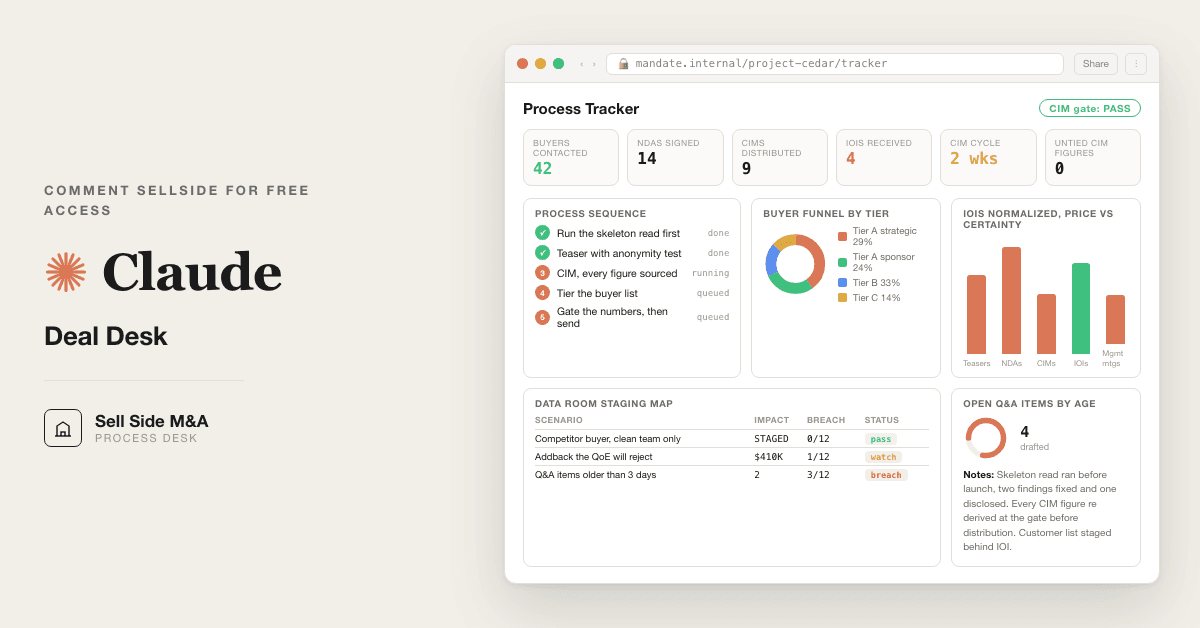
<task>Only after prompt 11 returns PASS: generate a single self-contained HTML file, the {{COMPANY_CODE}} process tracker, populated with THIS process's state. Cards: buyers contacted by tier, NDAs signed, CIMs out, IOIs in with the normalized comparison headline, open Q&A items by age, next milestones with dates. Inline CSS only, no external assets, dark ink on paper white, readable printed. Buyer codes and {{COMPANY_CODE}} only, never real names.</task>
<output_format>The complete HTML in one block, ready to save and open.</output_format>
<constraints>Every number comes from prompts 02 to 11; no new figures may appear here. If prompt 11 returned BLOCK, refuse and restate what unblocks it. Claude Opus 5.</constraints>
<trap>A tracker with real buyer names on a screen in a seller's office is how processes leak. Codes everywhere, always.</trap>
<review_gate>{{OWNER}} runs the process; the tracker shows it.</review_gate>

Got the prompts. Want them wired into your actual stack? We map that on a free AI audit.

Book the free audit
🔥 optional · live interactive tool

Open the Deal Process Tracker

Browser-based. No signup. Drop in your numbers and see the trade in real time. Opens in a new tab so the prompts stay where you left them.

Launch the live tool ↗

Rent it forever, or own it once.

For boutique M&A advisors and business brokers: draft the teaser, the CIM, and the buyer list in Claude Opus 5, not a six week cycle

Path A · free

You just did it

The setup rail and every prompt above are free and stay free. The cost is your time, and the risk of wiring it wrong on live data.

Back to the prompts ↑
Path B · done with you

We wire it into your business

The vault is about 70% of the work on a static mandate. We wire the rest into production in your environment: a standing desk per mandate, Q&A files on rails, and document verification that survives versioning. Reply "wire it" for a 30-minute slot.

Book a build call →
data safety

Before you use live numbers

  • • Run last quarter's numbers first. Live data is not a test bed.
  • • Nothing here uploads to us. It runs in your own Claude account, on your own machine.
  • • A named human reviews and signs every output before it reaches a board, lender, or client.
  • • Mask account numbers and names to the minimum the task needs.
the fine print

Straight answers on ownership

Prompt set authored by consultance.ai. Process drafting support, not investment banking, broker dealer services, legal or valuation advice; whether your role requires registration depends on your deal's facts and your counsel. Company documents stay in your own Claude tenant; we never see them.

Want this running in your business, not just your laptop? We build it and hand you the keys.

Book a build callBack to the library

Want this wired into your stack instead of running it yourself? That is our AI deal desk and finance automation service.

the newsletter

AI news worth opening.

The AI tools, launches, and shifts that actually matter, in plain English. New library drops the moment they land.

100% freeNo paywall, everUnsubscribe anytime

More like this

Other builds worth a weekend

All repos →
Finance and data

Free Portfolio Quant Research Desk

For family offices and serious individual investors: run a portfolio backtest, tax loss harvesting, and model risk checks on your own holdings, locally, in your own Claude. Replaces the $250k quant seat you would otherwise hire.

Setup guide →
Finance and data

Private Equity Deal Sourcing Playbook

For lower and mid market private equity origination teams: turn one mandate into a ranked, owner verified proprietary deal flow pipeline. Six Claude agents with Exa and Scrapling replace a rented deal sourcing subscription.

Setup guide →
Finance and data

Free Jira Alternative for Deal Teams

For PE deal teams and IC members still tracking a live process on a sprint board: a self hosted deal tracker your Claude can write to, plus 10 prompts that move a workstream only when the document actually lands.

Setup guide →
Get the free kitBook a call

Forward this to whoever owns the workflow.

The person drowning in this every week is the one who'll actually want it.

Forward by email
in one line

What is Free Sell Side Deal Desk?

Free Sell Side Deal Desk is a finance and data build in the consultance.ai AI Build Library. For boutique M&A advisors and business brokers: draft the teaser, the CIM, and the buyer list in Claude Opus 5, not a six week cycle. Built to replace the $250K junior banker year. It fits Boutique M&A advisors, business brokers, founders selling their own company and corp dev teams running divestitures without a bulge bracket team. Setup difficulty is Medium, with 4 plain-English steps.

What does Free Sell Side Deal Desk do?

For boutique M&A advisors and business brokers: draft the teaser, the CIM, and the buyer list in Claude Opus 5, not a six week cycle. Built to replace the $250K junior banker year.

Who is Free Sell Side Deal Desk for?

It fits Boutique M&A advisors, business brokers, founders selling their own company and corp dev teams running divestitures without a bulge bracket team.

How hard is Free Sell Side Deal Desk to set up?

Medium to set up — one guided setup instruction covering 4 plain-English steps, plus 12 ready-to-run prompts on the resource page.

How would consultance.ai build this out?

The vault is about 70% of the work on a static mandate. We wire the rest into production in your environment: a standing desk per mandate, Q&A files on rails, and document verification that survives versioning. Reply "wire it" for a 30-minute slot.

What are the licensing terms?

Prompt set authored by consultance.ai. Process drafting support, not investment banking, broker dealer services, legal or valuation advice; whether your role requires registration depends on your deal's facts and your counsel. Company documents stay in your own Claude tenant; we never see them.

Want this built into your workflow?

Free Sell Side Deal Desk is the starting point. On a free AI audit we map where it fits your stack and what consultance.ai would build around it.

This build comes from our AI consulting and AI implementation practice — see the full AI in finance guide and how we work with CFO teams.

Book your free AI audit