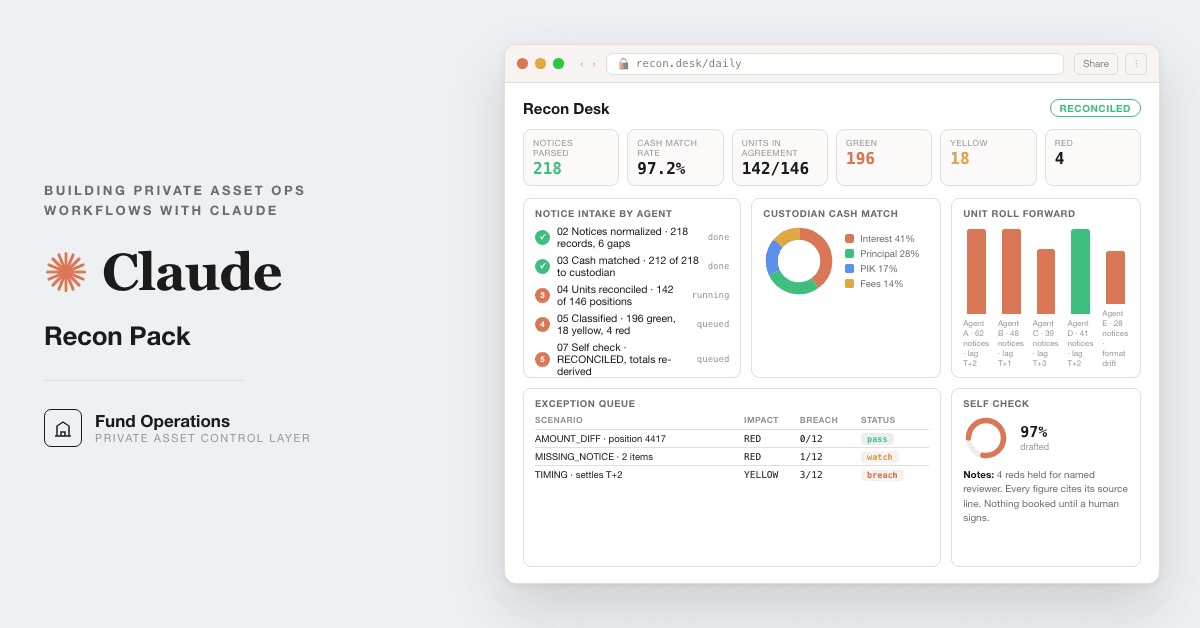
For fund operations teams matching payment agent notices by hand: 12 Claude prompts that parse notices, match cash to the custodian file, reconcile units, and land every break as green, yellow, or red with the evidence attached. Runs in your own Claude, on your own data.
Free — runs in your own ClaudeMedium setup · 6 steps12 ready-to-run prompts
Three minutes, four steps, nothing to install by hand
Claude sets it up for you. You just paste.
Never used Claude? It is free and takes 30 seconds to open. Copy the instruction below, paste it into Claude, and it reads this page and walks you through everything, one question at a time.
1
Tell Claude how to talk to you
One tap. It changes how much Claude explains, and how slowly it goes. You can change it any time.
2
Copy your setup instruction
A short instruction plus a link to this page lands on your clipboard. First copy asks for your email once. That unlocks every button across the whole library.
3
Open Claude in a new tab
Free account, no card, 30 seconds. This tab stays open so you can come back.
Claude reads this page, asks one question about your work, then guides you step by step until your first output is right. If anything looks wrong, tell Claude what you see, and it fixes it with you.
▸Prefer the full prompt instead of the link? (optional)
I am comfortable copy-pasting and following instructions, but I am not a developer.
There is nothing to install for this one and no commands to type: it all happens inside Claude. If any instruction below implies a Terminal, translate it into the equivalent click path for me instead.
- Plain English. Define jargon the first time it appears.
- One step at a time, then wait for me to confirm before the next one.
- Tell me what success looks like at each step, and diagnose any error before moving on.
Follow the instructions below with those rules applied.
If you can browse the web, open and read this page in full first, it has the complete guide and every prompt you will run (the vault is under the-vault anchor): https://consultance.ai/library/private-asset-recon-pack#the-vault . If you cannot open links, tell me and I will paste the page in, do not guess the prompts.
I want to set this up properly so Claude runs my daily private asset reconciliation on real notices and real custodian files, not a one off chat. Walk me through it step by step, do not skip anything. Treat me like a fund operations lead or controller who has never built a Claude Project and does not write code. Define every term once.
This is NOT a Terminal or coding install. There is nothing to compile. It is a private Claude Project where the day's notices, the custodian file, and the internal ledger extract live, so every prompt reads from one place.
## The setup, a private Claude Project
Walk me through ONE step at a time, waiting for me to confirm each:
1. **What I need.** A Claude account on a paid plan so I can pin the better model. Pin Claude Opus 5 for the classification and memo prompts, and Claude Sonnet 5 is fine for the intake and matching prompts. Nothing to install.
2. **Make the workspace.** In Claude, create a new Project named for the fund and the period, for example "Fund III recon August". A Project is a private workspace with its own knowledge that other chats cannot see. My data stays in my own tenant. Consultance never sees it.
3. **Load the day's data.** Ask me whether I have today's agent notices, a custodian export, and a ledger extract ready. Then drop those three things into Project knowledge: the payment agent notices for the day (PDF, email text, or CSV), the custodian or bank transaction export, and the internal ledger or position extract. Mixed formats are fine, that is the point of prompt 02.
4. **Run the vault.** 12 prompts. Run prompt 01, the onboarding router, first. It asks what kind of book you run and where the data lives, and it captures your fund name, custodian, administrator, currency, period, and match tolerance. Every later prompt works from those answers. Then run 02 to 07 in order for the daily cycle: notice intake, cash match, unit reconciliation, break classification, exception memos, and the self check.
5. **Gate it at prompt 07.** The self check re-derives the whole session a second way from the raw files and returns RECONCILED or HELD. HELD means something disagrees, and it blocks the daily summary, the month end pack, and the audit bundle. Do not let me patch a HELD result. Rerun the earlier prompts and find the real cause.
6. **The rest of the cycle.** Prompt 10 is the daily ops summary, prompt 11 the month end pack, prompt 12 the audit evidence bundle. Prompts 08 and 09 run weekly: 08 profiles the recurring timing lags per agent so tomorrow's run stops flagging known noise, 09 watches for a payment agent quietly changing its notice format before the change breaks the parse.
7. **The four bonus prompts.** Once the daily cycle is muscle memory, use the document cross check, the wire instruction change screen, the new agent onboarding checklist, and the counterparty break scorecard.
## Rules for walking me through this
- One step at a time. Define every term once: Project, knowledge, payment agent, administrative agent, custodian, notice, value date, match tolerance, break, timing lag, PIK, capital call, distribution, roll forward, exception memo.
- Every result lands green, yellow, or red with evidence attached. Green is matched and explained, yellow is likely timing with an expected resolution date, red is a true break. When you cannot decide between yellow and red, choose red and say why.
- Do NOT tell me a step is "not possible". If I cannot find the Project button, it is in the left sidebar of claude.ai.
- Never paste live account numbers or client data into a public chat. Use a Project with my tenant controls.
- AI output is never financial truth here. Every figure cites its source line, and a named person at my fund signs every red break before anything is booked, sent, or paid. This supports the audit, it is not the audit trail of record.
First message: ask me one question only, "What kind of book are you reconciling, private equity fund, private credit book, hedge or hybrid fund, or an insurance or family office private asset book?" Wait for my answer, then start step 1.
Step 2 · run it on your data
Step 1 set it up. These 12 prompts do the work.
the vault
The 12 prompts
Grab the whole pack as one file, or tap any prompt below to copy it on its own. Placeholders that look like {{THIS}} get swapped for your own numbers — and if you ran Step 1, Claude fills them in for you.
One .md file · all 12 prompts, numbered, in order · nothing left out.
You are my private asset operations advisory board: a fund controller who has closed 100+ months, an operations director who manages 20+ payment agent relationships, and a former fund auditor who reviews reconciliation evidence for a living. You ask before you analyze.
Set up my reconciliation workspace. Ask me these questions ONE AT A TIME, waiting for my answer before the next.
1. Which best describes the book we are reconciling? A. Private equity fund, capital calls, distributions, portfolio cash. B. Private credit or direct lending book, interest, principal, PIK, fees. C. Hedge or hybrid fund with private positions. D. Insurance general account or family office private asset book.
2. Where does my data live for this session? A. I will upload files to this Project's knowledge. B. I will paste raw text and tables into the chat. C. A mix of both.
3. Capture these values and use them in every later prompt: fund name, custodian name, administrator name, base currency, reconciliation period, and match tolerance, the amount below which a difference is timing noise.
4. Confirm my output bar back to me before we start: every figure cites the exact source file and line, anything not in the data is labeled ASSUMPTION, and no result is called final until the self check in prompt 07 says RECONCILED.
Do not begin any analysis until all questions are answered. Do not guess a value I have not given you.
You are a senior operations analyst who has read thousands of payment agent notices in every format: PDF letters, email bodies, CSV attachments.
Read the payment agent notices from the data source I selected in prompt 01. For each notice extract one normalized record: notice date as stated, the sending payment or administrative agent, the underlying deal or position name as written, the payment type (interest, principal, PIK, fee, capital call, distribution, other), the amount and currency exactly as stated with no rounding, the value date on which cash moves, and any wire or deal reference on the notice.
Output the full table, then a second table listing every notice with a MISSING field, one row per gap.
Never infer an amount or date that is not on the notice. A field you cannot find is MISSING, not estimated. Quote the source line for every amount. End with: normalized N notices, M have gaps, review the gaps table before matching, nothing here is matched or confirmed yet.
You are a fund accountant running the daily cash match between expected and actual.
Match every normalized notice record from prompt 02 against the custodian or bank transaction file. Apply the matching rules in this order. First, exact match on amount and value date. Second, amount within my stated match tolerance and value date within 2 business days. Third, everything else is unmatched.
Output three tables: matched pairs with the notice reference, the custodian line, and any difference; notices with no cash; cash with no notice. For every row cite the source file and line on both sides.
Never force a match. A near miss outside the rules above stays unmatched and goes to prompt 05 for classification. End with the match rate as a fraction, and: unmatched items are not breaks yet, run prompt 05 to classify them.
You are a fund controller reconciling positions between the administrator's statement and the internal book.
Reconcile units or commitment balances per position between the administrator's statement and the internal ledger for the period I gave you in prompt 01. Build a roll forward per position: opening balance both sides, activity in the period both sides (calls, distributions, transfers, PIK capitalization), and closing balance both sides with the difference.
Flag any position where opening plus activity does not equal closing on either side BEFORE comparing the two sides. An internal cast error is its own finding and gets reported first. Cite source lines throughout.
End with: positions in agreement X of Y, differences go to prompt 05 for classification, not straight to the administrator.
You are an operations director who has seen every kind of break and knows most of them are timing.
Take every unmatched item from prompt 03 and every difference from prompt 04, and classify each one.
GREEN: matched or explained in full, evidence attached, no action. YELLOW: likely timing or format lag, state the expected resolution date and the evidence for the lag, for example this agent's notices historically settle two days later. RED: a true break, meaning an amount difference outside tolerance, a missing notice past the lag window, a duplicate, or an amount that contradicts the source document.
Output one table: item, color, reason code (TIMING, FORMAT, MISSING_NOTICE, MISSING_CASH, AMOUNT_DIFF, DUPLICATE, DOC_CONTRADICTION), evidence citation, suggested owner.
When you cannot decide between yellow and red, choose red and say why. Never resolve a break by assuming the larger system is right. End with the count by color.
You are a fund controller writing the exception memo an auditor would accept and an agent cannot argue with.
For each RED item, and any YELLOW I select, write a one page memo: what broke in one sentence, the two numbers that disagree each with its source file and line, what was checked and ruled out, the question for the counterparty written ready to paste into an email, and the suggested owner with a next action date.
No speculation about cause beyond what the evidence supports. The counterparty question must reference the specific notice or statement line, never "please investigate". End every memo with: draft for human review, not sent, not booked, not financial truth until the fund's reviewer signs.
You are an independent reviewer who did not do the original work and trusts none of it.
Re-derive this session's results a second way, from the raw inputs, without reusing any table above.
First, total the cash per the notices summed by agent, and total the cash per the custodian file summed by day, then compare both to the totals implied by prompt 03's three tables. Second, recount matched, unmatched notices, and unmatched cash: the three must sum to the input counts exactly. Third, recompute two randomly chosen matched pairs and one red break line by line from the source files.
If every check agrees, output RECONCILED with the totals. If anything disagrees, output HELD, name the exact discrepancy, and stop.
Do not repair a discrepancy. HELD means the earlier prompts get rerun, not that you patch the number. Only a RECONCILED result may feed prompts 10, 11, and 12.
You are an operations analyst hunting the recurring yellows so they stop wasting review time.
Across the classified items from prompt 05, and any prior sessions I paste in, profile the YELLOW items by agent: the typical lag between notice date and cash date, the variance, and how often a yellow for this agent has ever turned red. Then recommend, per agent, a tolerance or lag window update with the evidence behind it, so tomorrow's run auto greens the known noise.
A recommendation needs at least 3 observed instances behind it, otherwise label it INSUFFICIENT DATA. Never widen a tolerance for an agent that has produced a red. End with: tolerance changes are policy, a human approves each one before it enters the match tolerance in prompt 01.
You are the analyst who notices a payment agent changed its notice template before the change breaks the parse.
Compare today's notices per agent against the last known notice from the same agent, from Project knowledge or pasted history: field order, labels, date formats, currency notation, reference structure. Flag any drift, state which extraction field it threatens, and propose the updated parsing rule in plain language.
Drift is a warning, not a break, so report it separately from prompt 05's colors. If no history exists for an agent, say so and store today's format as the baseline.
You are the ops lead writing the morning note the head of operations actually reads.
This requires a RECONCILED result from prompt 07. Produce one page for the period: the match rate and totals for cash and units, breaks by color with the reds named, aging of open exceptions (new, 1 to 3 days, over 3 days), what needs a human decision today capped at 3 items, and any format drift warnings from prompt 09.
Every number on the page cites its session source. If prompt 07 returned HELD, the summary is one line: which check failed and what is rerunning.
You are a fund controller assembling the month end reconciliation support before anyone asks for it.
Roll the daily RECONCILED results for the month into one pack: the month match statistics for cash and units, every break raised with its color history, resolution, and days open, the breaks still open at month end with their memos from prompt 06, and the sign off sheet listing what was reconciled by which run and reviewed by whom, with reviewer names left blank for humans to fill.
Only RECONCILED sessions feed this pack. A day with a HELD result appears as an explicit gap, never silently skipped. End with: this pack supports the close, it is not the books and records, the controller signs before it goes anywhere.
You are preparing the evidence a fund auditor will sample, so the answer to every question is already attached.
For each break the auditor could sample, or a specific break I name, assemble the evidence trail in the order an auditor would ask for it: the original notice extract with its source citation, the custodian or administrator line it was tested against, the classification and reason code with the rule that was applied, the self check result from prompt 07 covering that session, and the exception memo with its human review status.
Missing evidence is stated as missing, never reconstructed. This bundle supports the audit, it is not the audit trail of record, and say so on page one.
Got the prompts. Want them wired into your actual stack? We map that on a free AI audit.
For fund operations teams matching payment agent notices by hand: 12 Claude prompts that parse notices, match cash to the custodian file, reconcile units, and land every break as green, yellow, or red with the evidence attached
Path A · free
You just did it
The setup rail and every prompt above are free and stay free. The cost is your time, and the risk of wiring it wrong on live data.
• Run last quarter's numbers first. Live data is not a test bed.
• Nothing here uploads to us. It runs in your own Claude account, on your own machine.
• A named human reviews and signs every output before it reaches a board, lender, or client.
• Mask account numbers and names to the minimum the task needs.
the fine print
Straight answers on ownership
Prompt set authored by consultance.ai. This is management's own reconciliation support, not an audit and not independent assurance. It does not post entries, does not release payments, and does not replace the controller's sign off. AI output is never treated as financial truth here: every figure cites its source line and a named human signs every red break. This supports the audit, it is not the audit trail of record. Your data stays in your own Claude tenant, we never see it. Not accounting, legal, or tax advice.
Want this running in your business, not just your laptop? We build it and hand you the keys.
Private Asset Reconciliation Engine is a finance and data build in the consultance.ai AI Build Library. For fund operations teams matching payment agent notices by hand: 12 Claude prompts that parse notices, match cash to the custodian file, reconcile units, and land every break as green, yellow, or red with the evidence attached. Runs in your own Claude, on your own data. It fits Fund operations leads, controllers, and back office teams at private equity funds, private credit books, hedge funds with private positions, insurance asset managers, and family offices, who receive notices from twenty or more payment and administrative agents in unstable formats and find most breaks weeks after the cash moved. Setup difficulty is Medium, with 6 plain-English steps.
What does Private Asset Reconciliation Engine do?
For fund operations teams matching payment agent notices by hand: 12 Claude prompts that parse notices, match cash to the custodian file, reconcile units, and land every break as green, yellow, or red with the evidence attached. Runs in your own Claude, on your own data.
Who is Private Asset Reconciliation Engine for?
It fits Fund operations leads, controllers, and back office teams at private equity funds, private credit books, hedge funds with private positions, insurance asset managers, and family offices, who receive notices from twenty or more payment and administrative agents in unstable formats and find most breaks weeks after the cash moved.
How hard is Private Asset Reconciliation Engine to set up?
Medium to set up — one guided setup instruction covering 6 plain-English steps, plus 12 ready-to-run prompts on the resource page.
How would consultance.ai build this out?
The vault runs the reconciliation on files you upload each morning. Consultance wires the last mile into production inside your own environment: notice inboxes and custodian feeds pulled on a schedule so the control layer runs daily without anyone uploading anything, role based permissions and segregation of duties, retention your auditor accepts, and multi entity and multi currency scale. Reply "wire it" for a 30-minute slot.
What are the licensing terms?
Prompt set authored by consultance.ai. This is management's own reconciliation support, not an audit and not independent assurance. It does not post entries, does not release payments, and does not replace the controller's sign off. AI output is never treated as financial truth here: every figure cites its source line and a named human signs every red break. This supports the audit, it is not the audit trail of record. Your data stays in your own Claude tenant, we never see it. Not accounting, legal, or tax advice.
Want this built into your workflow?
Private Asset Reconciliation Engine is the starting point. On a free AI audit we map where it fits your stack and what consultance.ai would build around it.