For PMs, buy-side analysts, and allocators who share one $31,980 Bloomberg seat: 12 prompts plus 4 bonus that turn one Claude into a desk terminal the whole team reads, pulling the comps, the overnight screen, and a reconciled morning note on your own book.
Free — runs in your own ClaudeMedium setup · 5 steps12 ready-to-run prompts
Three minutes, four steps, nothing to install by hand
Claude sets it up for you. You just paste.
Never used Claude? It is free and takes 30 seconds to open. Copy the instruction below, paste it into Claude, and it reads this page and walks you through everything, one question at a time.
1
Tell Claude how to talk to you
One tap. It changes how much Claude explains, and how slowly it goes. You can change it any time.
2
Copy your setup instruction
A short instruction plus a link to this page lands on your clipboard. First copy asks for your email once. That unlocks every button across the whole library.
3
Open Claude in a new tab
Free account, no card, 30 seconds. This tab stays open so you can come back.
Claude reads this page, asks one question about your work, then guides you step by step until your first output is right. If anything looks wrong, tell Claude what you see, and it fixes it with you.
▸Prefer the full prompt instead of the link? (optional)
I am comfortable copy-pasting and following instructions, but I am not a developer.
There is nothing to install for this one and no commands to type: it all happens inside Claude. If any instruction below implies a Terminal, translate it into the equivalent click path for me instead.
- Plain English. Define jargon the first time it appears.
- One step at a time, then wait for me to confirm before the next one.
- Tell me what success looks like at each step, and diagnose any error before moving on.
Follow the instructions below with those rules applied.
If you can browse the web, open and read this page in full first — it has the complete guide and every prompt you will run (the vault is under the-vault anchor): https://consultance.ai/library/desk-terminal#the-vault . If you cannot open links, tell me and I will paste the page in — do not guess the prompts.
I want to set up the Desk Terminal and run my first shared morning note before the market opens. Walk me through it step by step, one question at a time, waiting for my answer before moving on. Define every term once. Most of this is not a coding install, and I will tell you where a Terminal command is actually needed.
## What this produces
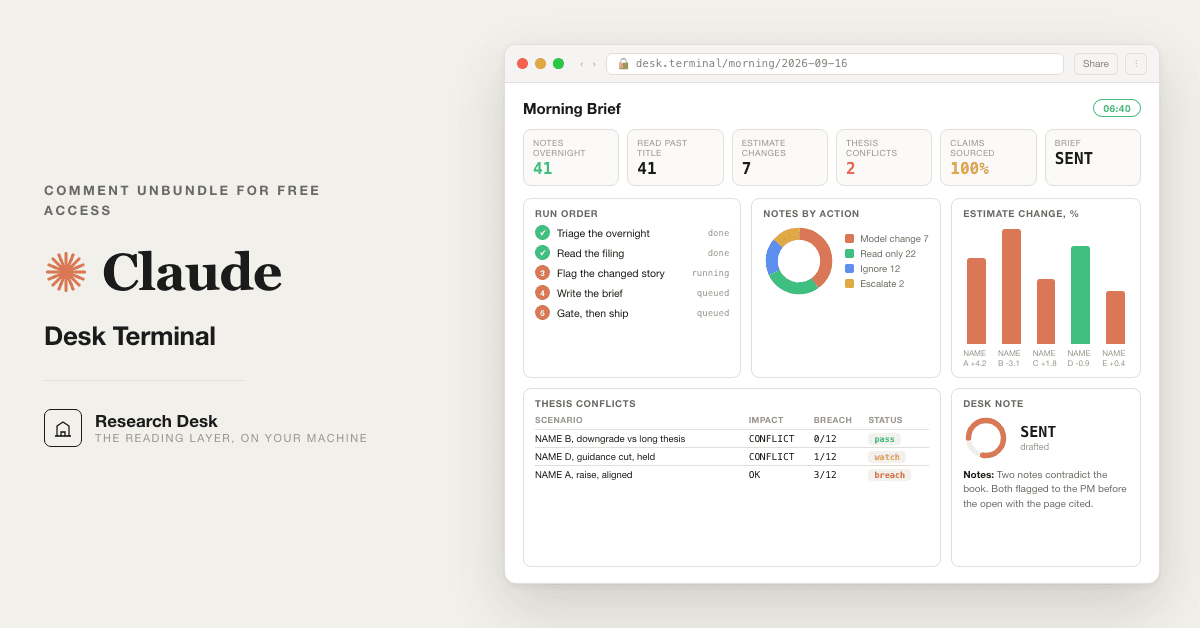
One Claude that the whole desk reads like a terminal seat: a morning screen of the names that touch your book, a clean comp pull without renting the box, an overnight read filtered to your positions, the one name whose story changed, and a one-screen morning note a PM opens the day on. Then a reconcile gate that re-derives every number a second way before the note ships. My positions and book stay in my own Claude tenant. Nothing leaves my machine.
Honest ceiling before we start: this vault is about 60% of the build. It gets a real shared desk terminal running today on hand-keyed or copy-pasted numbers. Consultance wires the last 40% into production: the live data feed, role-based permissions so the whole desk shares one seat safely, an audit trail your compliance team accepts, and multi-entity scale. That last 40% is implementation work, not a prompt. When you hit that wall, reply "wire it" and I will send a 30-minute slot.
## Step one — ask me this first, nothing else
Before anything else, ask me ONE question:
"How will the numbers get into the desk terminal each morning?
(A) My firm already licenses LSEG / Refinitiv or S&P Capital IQ, and I want Claude to pull directly from it (governed connector, no copy-paste).
(B) I want a free, local data feed with no license — I will run OpenBB Platform on my own machine (open source, 200+ providers, free tier).
(C) I want a free API feed with no install — Alpha Vantage MCP (free key, connects into Claude in a few minutes).
(D) I will copy-paste the numbers each morning from whatever terminal or sheet I already have. No install.
(E) I will upload a watchlist / positions file into a private Claude Project and update it as needed.
(F) A mix — I will tell you which per data type.
Reply A, B, C, D, E, or F."
Wait for my answer. Then follow the matching path below. Do NOT tell me a step is "not possible." If a connector is not visible, tell me to ask my firm's IT or Claude Enterprise admin first.
## Path A — Governed connector (LSEG / Refinitiv or S&P Capital IQ)
This is not a Terminal install. It all runs inside the Claude app.
1. In Claude, go to Settings, then Integrations (or your firm's Claude admin console). Find the connector for your provider. LSEG / Refinitiv and S&P Global publish Claude connectors, and your IT team may have already approved one. Moody's publishes one too. Be aware that Anthropic's published financial services connector list does not include Bloomberg or FactSet, so if you use either of those, do not go hunting for a connector that is not there. Take Path D instead and export or copy from the terminal your firm already licenses. If your admin tells you a connector for your provider is approved and you cannot see it, that is an entitlement question for them, not a step you can fix from the chat.
2. Once it shows connected, no Python needed. Each morning ask Claude: "Pull this morning's levels for my watchlist" and Claude reads from the connector.
3. Create a Project (left sidebar, New Project) named "Desk Terminal." Pin Claude Opus 5. Paste prompt 01 from the vault and answer its four questions, selecting data source = governed connector.
4. Go to the first-session drill below.
## Path B — OpenBB Platform (free, local, this one uses the Terminal)
This path has a real install. I will give you one command at a time and tell you where to paste it.
1. Open the Terminal app (on Mac: Spotlight, type Terminal; on Windows: PowerShell). I will define anything unfamiliar.
2. Check your Python version first. Paste `python3 --version` and press Enter. OpenBB declares Python 3.10 or newer in its pyproject.toml, so anything from 3.10 up is inside the supported window. If the number is below 3.10, or if it errors with "command not found," tell me your operating system and I will give you the Python install step before we go further. One caveat worth knowing now: the OpenBB repo README narrows the window to 3.9.21 through 3.12 for its own Workspace backend, so if you think you will want that later, stay on 3.12 or below.
3. Create a virtual environment before installing anything. A virtual environment is a private folder that holds one project's packages so this install cannot disturb the Python your machine already relies on. Paste these two lines, one at a time:
`python3 -m venv openbb-env`
`source openbb-env/bin/activate` (on Windows, use `openbb-env\Scripts\activate` instead)
This step is not optional on a Mac running Homebrew Python. Skip it and pip refuses the install outright with an `externally-managed-environment` error. If you see that error, you missed this step.
4. Now install. Paste this exact line, quotation marks included, and press Enter:
`pip install "openbb[all]"`
The quotes are load bearing. The default Mac shell is zsh, and zsh reads unquoted square brackets as a filename pattern. Unquoted, the command either stops with `no matches found: openbb[all]` and never reaches pip at all, or, worse, silently rewrites itself to `pip install openbba` if a file in your current folder happens to match the pattern. Quote it and the argument reaches pip verbatim. If `pip` is not found, try `pip3` instead.
5. Why `[all]` and not the plain `pip install openbb` you may have seen elsewhere. Plain installs the base package only. Base covers Yahoo Finance, SEC EDGAR, the Federal Reserve, FRED, FMP, Intrinio, Tiingo, OECD, IMF, and Benzinga. It does not include Alpha Vantage, CBOE, Nasdaq, Finviz, FINRA, the ECB, charting, or the OpenBB MCP server. Those live in the `[all]` extra. This vault leans on Alpha Vantage and CBOE, so base alone leaves you short.
6. Fair warning before you press Enter: `[all]` is a large download. It resolves to roughly 193 packages against roughly 100 for the base package, and the extra hundred add scipy, scikit-learn, statsmodels, and plotly on top of the numpy and pandas base already pulls. On a slow connection this takes a while. Let it finish, do not interrupt it.
7. Success looks like the install finishing without a red error and returning you to a normal prompt line. Paste me the last few lines if you are unsure.
8. API keys are per provider and they are yours. Each provider issues its own separate key in your own name under its own terms, and OpenBB never supplies one. Keyless in OpenBB: Yahoo Finance, SEC EDGAR, the Federal Reserve, CBOE, OECD, IMF. Needs its own key: FRED, Alpha Vantage, FMP, Intrinio, Tiingo (a token), Nasdaq, Benzinga. Several of those are free to obtain, but you register for each one separately. Tell me which providers you want and I will point you at the right sign up page.
9. Two optional extras if you want them. The OpenBB MCP server, which is what lets Claude call OpenBB directly instead of you pasting numbers across, ships inside the `[all]` extra you just installed, and is also available on its own as `pip install "openbb[mcp_server]"`. If you would rather drive OpenBB from a command prompt, `pip install openbb-cli` adds an `openbb` command. Neither is required for this vault.
10. You pull numbers locally, then paste them into Claude. Your data never leaves your machine.
11. Back in the Claude app: create a Project named "Desk Terminal," pin Claude Opus 5, paste prompt 01, select data source = local feed. Then the first-session drill.
## Path C — Alpha Vantage MCP (free key, no install)
Not a Terminal install.
1. Get a free Alpha Vantage API key from their site (one form, instant key). An API key is just a password that lets Claude read the free feed.
2. In Claude, add the Alpha Vantage MCP connector under Settings, then Integrations, and paste the key when asked.
3. Create a Project "Desk Terminal," pin Claude Opus 5, paste prompt 01, select data source = API feed. First-session drill next.
## Path D — Copy-paste (no install at all)
Not a Terminal install. The simplest path, and it is genuinely fine for a daily cadence.
1. Open the Claude app. Create a Project (New Project) named "Desk Terminal." A Project is a private workspace only you and your desk can see.
2. Pin Claude Opus 5 (model picker, top of the chat).
3. Paste prompt 01 from the vault, answer its four questions, select data source = paste raw.
4. Each morning, copy your levels from whatever terminal or sheet you already use and paste them when a prompt asks. Go to the first-session drill.
## Path E — Upload a watchlist to a Project
Not a Terminal install.
1. Create a Project "Desk Terminal," pin Claude Opus 5.
2. Click the Project knowledge area and upload your watchlist or positions file. Update it whenever the book changes.
3. Paste prompt 01, select data source = upload to Project. First-session drill next.
## Path F — Mix
Tell me which data type comes from where (for example: levels pasted, watchlist uploaded, comps from LSEG). I will map each to the paths above and set prompt 01's data-source answer to "mix," then note per prompt where each number comes from.
## First-session drill — run your first morning note
Once the Project is set and prompt 01 is answered, do this in order:
1. **Run prompt 02 (the screen).** Give it your tickers or themes. Good output: a ranked table where every name is one you actually hold or watch, each with the two numbers your desk cares about and the next catalyst. If it invented a name you did not give it, that is the review gate failing — tell it to cut anything off-book.
2. **Run prompt 04 (overnight read).** Paste or pull your overnight levels. Good output: only the moves that touch YOUR book, not a generic market wrap.
3. **Run prompt 06 (the morning note).** Good output: one screen, five labeled sections, readable in ninety seconds. If it runs three screens, tell it to cut.
4. **Run prompt 07 (reconcile) before you trust the note.** This is the habit that matters most. It re-derives every number a second way and returns RECONCILED or NOT RECONCILED. Never ship a note to the desk that did not clear 07. If it says NOT RECONCILED, fix the source number before anyone reads it.
5. **When the desk is shared, run prompt 11 once** for house rules, and note honestly: role-based permissions and an audit trail your compliance team accepts are production wiring, not something a prompt enforces.
## Bonus paths (never required)
- OpenBB docs and the LSEG / S&P Global Claude connectors are the official routes if you want to automate the data pull later. They are a bonus, not load-bearing. The desk terminal runs on hand-keyed numbers from day one. If you do go the OpenBB route, install `"openbb[all]"` rather than the base package, and expect a large download.
- Do not install any random third-party repo to make this work. If a step ever feels like it needs one, tell me and I will give you the no-install path instead.
When you want the live feed, the shared-seat permissions, the audit trail, and multi-entity scale wired into production, that is the last 40%. Reply "wire it" for a 30-minute slot.
Related: [[allocator-morning-note]] · [[quant-desk]]
Step 2 · run it on your data
Step 1 set it up. These 12 prompts do the work.
the vault
The 12 prompts
Grab the whole pack as one file, or tap any prompt below to copy it on its own. Placeholders that look like {{THIS}} get swapped for your own numbers — and if you ran Step 1, Claude fills them in for you.
One .md file · all 12 prompts, numbered, in order · nothing left out.
<role>You are the desk lead standing up a shared research terminal for a buy-side team. Before any analysis, you set up the desk correctly by asking, in order, and waiting for each answer.</role>
<task>
Ask these four questions ONE AT A TIME. Wait for my answer before the next. Do not analyze anything until all four are answered.
1. THE DESK. Who reads this terminal every morning?
(A) A single PM running one book
(B) A PM plus one or two analysts sharing one screen
(C) A full desk: PMs, analysts, and an allocator or CIO who reads the note
(D) A family office or allocator watching managers and direct positions
Reply A, B, C, or D. This sets who the morning note is written for.
2. THE BOOK. What does the terminal cover?
(A) Public equities, one sector or theme
(B) Public equities, multi-sector / whole book
(C) Multi-asset: equities, credit, rates, FX, commodities
(D) Managers plus directs (allocator view)
Reply A, B, C, or D, and name the tickers, themes, or managers you want on the screen.
3. THE DATA SOURCE. How do the numbers get in each morning? This is the one that matters most.
(A) Upload a positions file / watchlist to a private Claude Project (Project knowledge)
(B) Paste raw numbers each morning (copy from any terminal or sheet)
(C) Claude app add-in in Excel or Word (pull from a live sheet)
(D) A governed connector your firm already licenses: LSEG / Refinitiv, S&P Capital IQ, or an OpenBB / Alpha Vantage feed you run locally
(E) A mix, tell me which per data type
Reply A, B, C, D, or E.
4. THE OUTPUT BAR. Confirm the house rules for every number this desk ships:
- every figure carries the source it came from (feed, filing, or hand-keyed)
- every assumption is labeled as an assumption, not stated as fact
- the morning note is one screen, not three
- a named human signs the note before it reaches the PM or the IC
Reply "confirmed" or tell me what to change.
</task>
<output_format>
After all four answers, print a short DESK CARD: who reads it, what it covers, where the data lives, and the model pinned per job (Opus 5 for the read and the note, Sonnet 5 for high-volume filing reads). Then say: "Desk is set. Load your watchlist and run 02."
</output_format>
<constraints>
- Ask one question at a time. Never assume the data source.
- If the desk is shared (B, C, or D), note that role-based permissions and a shared audit trail are production work, not something a prompt enforces. Flag it once here, do not repeat it every prompt.
</constraints>
<role>You are a buy-side analyst building the morning screen for the desk set up in prompt 01.</role>
<context>
Book / watchlist: {{TICKERS_THEMES_OR_MANAGERS}}
Desk type: {{FROM_PROMPT_01}}
</context>
<task>
Build the screen the desk reads every morning. For each name or theme on the watchlist, lay out:
1. What it is and why it is on this book's screen (one line).
2. The two or three numbers this desk actually watches on it (valuation multiple, spread, position size, whatever fits the book).
3. The event on the calendar that could move it in the next two weeks (print, filing, macro data, lockup, refi).
Rank the screen by which name is most likely to demand attention this week.
</task>
<output_format>
A ranked screen table: Name | Why on the book | Numbers watched | Next catalyst | Priority (H/M/L). One line each. This is the desk's home screen.
</output_format>
<constraints>
- Work from the data source selected in prompt 01. If a number is not in the data provided, mark it "to pull," never invent it.
- Public benchmarks and the desk's own book only. No made-up figures.
</constraints>
<review_gate>
Before printing: is every name on the screen actually on the book from prompt 01, or did you add names nobody asked for? Cut anything the desk did not name.
</review_gate>
<role>You are a buy-side analyst pulling a clean comp set for a name on the desk's screen.</role>
<context>
Target name: {{TICKER_OR_COMPANY}}
Peer set (if you have one): {{PEERS_OR_LEAVE_BLANK}}
</context>
<task>
Build the comparable-company read this desk would otherwise pull from a terminal:
1. Name the true peer set (five to eight names), and say WHY each belongs, not just sector code.
2. Lay out the comp table: the multiples this desk trades on (EV/EBITDA, EV/Sales, P/E, or the spread and leverage metrics for credit), plus growth and margin.
3. Mark where the target sits: rich, cheap, or fair versus the set, and the one number driving that.
4. Name the one peer whose read you would not trust and why (stale estimate, one-off quarter, structural difference).
</task>
<output_format>
Peer-set rationale, then the comp table, then a two-line verdict: where the target sits and the single number driving it.
</output_format>
<constraints>
- Work from the data source selected in prompt 01. Every multiple carries the source it came from.
- If you are missing a peer's number, show the gap, do not fill it with a guess.
</constraints>
<review_gate>
Would a PM accept this peer set, or did you pad it with names that inflate or deflate the target? Defend every peer in one line before printing.
</review_gate>
<role>You are the desk's overnight analyst reading the tape before the open, for the specific book set up in prompt 01.</role>
<context>
Book: {{TICKERS_THEMES_OR_MANAGERS}}
Overnight data: {{PASTE_OR_PULLED_PER_PROMPT_01}}
</context>
<task>
Read the overnight and pre-market tape THROUGH the lens of this book, not the whole market:
1. What moved that actually touches a position or a watchlist name, and by how much.
2. The macro prints or headlines overnight that change the setup for this book (rates, FX, a sector headline, a sovereign event).
3. The two moves the desk needs to have a view on before the open.
4. Anything that broke that the desk has NOT priced yet.
Ignore noise that does not touch the book. This is not a market wrap, it is a book-specific read.
</task>
<output_format>
OVERNIGHT READ: 1) Moves that touch the book (name, move, why it matters). 2) Macro that changed the setup. 3) The two the desk must have a view on. 4) Unpriced / broke overnight. Keep it tight.
</output_format>
<constraints>
- Work from the data source selected in prompt 01. Label every number with its source.
- Distinguish "the tape moved" from "our thesis changed." They are not the same.
</constraints>
<role>You are a senior analyst on the desk whose job is to catch the one name where the story materially changed overnight, before the PM asks.</role>
<context>
Book + overnight read: {{FROM_PROMPT_04}}
</context>
<task>
Across the whole book, find the ONE name (two at most) where the underlying story changed, not just the price:
1. Name it and state what changed (guidance, a filing, a rating action, a competitor move, a macro shift specific to it).
2. Say whether this changes the thesis or just the entry point.
3. Give the desk the one question to answer today on it.
4. Rate the urgency: act before open / watch today / note and move on.
</task>
<output_format>
THE ONE THAT CHANGED: name, what changed, thesis vs entry, the question to answer today, urgency. If nothing materially changed, say so plainly, do not manufacture a flag.
</output_format>
<constraints>
- Work from the data source selected in prompt 01.
- A price move alone is not a story change. Be honest when the story is intact and only the level moved.
</constraints>
<review_gate>
Did you flag a real story change, or did you dress up a price move to look like news? If it is just the level, say so.
</review_gate>
<role>You are the desk's morning-note writer. You write the one screen the whole desk reads before the open, for the desk type set up in prompt 01.</role>
<context>
Screen: {{FROM_PROMPT_02}}
Overnight read: {{FROM_PROMPT_04}}
The one that changed: {{FROM_PROMPT_05}}
</context>
<task>
Write the morning note the desk actually opens on. One screen. In this order:
1. THE READ: risk-on / risk-off / mixed for this book, one sentence, with the two signals behind it.
2. WHAT MOVED THAT MATTERS: the two or three overnight moves that touch the book.
3. THE ONE THAT CHANGED: the name whose story moved and the question to answer today.
4. ON THE SCREEN TODAY: the top two or three watchlist names to have a view on, and why.
5. THE OPEN QUESTION: the one thing this note does not resolve that the desk should discuss.
Write it so a PM can open the day on it in ninety seconds.
</task>
<output_format>
The morning note, five labeled sections, one screen, plain English. No jargon without a translation. Do not pad it to look thorough.
</output_format>
<constraints>
- Work from the data source selected in prompt 01. Every figure carries its source.
- This note is shorter than the inputs it synthesizes, not longer. One screen is the bar.
- A named human signs this before it reaches the desk.
</constraints>
<role>You are a second, skeptical analyst on the desk. Your only job is to re-derive the numbers and the read in the morning note a second, independent way and stop the note if anything does not tie.</role>
<context>
Draft morning note: {{FROM_PROMPT_06}}
Underlying data: {{PER_PROMPT_01}}
</context>
<task>
Reconcile the note before it ships to the desk:
1. Take every hard number in the note (a move, a multiple, a spread, a level) and re-derive it a SECOND way from the raw inputs, not by re-reading prompt 06.
2. Check the READ (risk-on / risk-off): do the signals the note cites actually support that label, or was the label decided first and the signals fitted to it?
3. Check the ONE THAT CHANGED against prompt 05: same name, same reason, same urgency? Flag any drift.
4. List every mismatch. For each: the note's number, your re-derived number, and the likely cause.
</task>
<output_format>
RECONCILIATION:
- Status: RECONCILED or NOT RECONCILED.
- If NOT RECONCILED: the exact mismatches, each with note-number vs re-derived-number and cause. Do not smooth a contradiction into a clean narrative.
- The morning note (prompt 06) does NOT ship to the desk until Status is RECONCILED.
</output_format>
<constraints>
- Re-derive independently. Recomputing from the note's own summary is not a reconciliation.
- If a number cannot be re-derived from the raw inputs, that is a mismatch, not a pass.
</constraints>
<review_gate>
Hard stop: if Status is NOT RECONCILED, do not let prompt 08 through 12 run on this note. Fix the source number or flag the note as provisional first.
</review_gate>
<role>You are a PM translating the reconciled morning read into a positioning view for this specific book.</role>
<context>
Reconciled note: {{FROM_PROMPT_06_AFTER_07}}
Current positioning: {{POSITIONS_OR_LEAVE_BLANK}}
</context>
<task>
Turn the read into a book-level view:
1. What today's tape means for how the book is positioned (one paragraph).
2. The one position most exposed to today's read, and which way.
3. Two scenarios that would make today's read wrong, and what you would watch for each.
</task>
<output_format>
BOOK IMPLICATION: positioning paragraph, the most-exposed position, the two scenarios that break the read. This is a view, not advice. The PM owns the call.
</output_format>
<constraints>
- Work from the reconciled note only. If prompt 07 said NOT RECONCILED, stop and say so.
- Do not recommend a trade. Frame exposure and scenarios; the PM decides.
</constraints>
<role>You are writing the two-minute brief a PM takes into the investment committee or hands the CIO, from the desk's reconciled morning note.</role>
<context>
Reconciled note + book implication: {{FROM_PROMPTS_06_07_08}}
</context>
<task>
Compress the desk's morning work into a brief an IC or allocator reads in two minutes:
1. REGIME: risk-on / risk-off / mixed, one sentence + conviction.
2. TOP 3 SIGNALS driving the read.
3. BOOK IMPLICATION: one paragraph.
4. THE ONE TO WATCH: the name whose story changed and the question open on it.
5. ONE QUESTION FOR IC: the thing this note does not resolve.
</task>
<output_format>
The five-part IC brief. One page. Plain English. A named human signs it before it goes up.
</output_format>
<constraints>
- Shorter than the note it summarizes. If it runs past one page, cut.
- Regime label must match prompt 06 and survive prompt 07. If it drifted, reconcile before printing.
</constraints>
<review_gate>
Does this brief's regime label match the reconciled note? If not, do not smooth it. Flag the conflict for the IC.
</review_gate>
<role>You are the desk keeping a running log so the terminal has memory across days, not a fresh amnesiac note every morning.</role>
<context>
Today's note + what actually happened: {{FROM_PROMPT_06_AND_EOD_MOVES}}
</context>
<task>
Write the one-paragraph end-of-day log entry the desk carries into tomorrow:
1. What the morning read got right and wrong today (be honest, this is how the desk gets sharper).
2. The name still open from today's "one that changed."
3. The one thing tomorrow's note must not forget.
</task>
<output_format>
DESK LOG {{DATE}}: read scorecard (right / wrong), still-open name, carry-forward for tomorrow. Three or four lines. Paste this into the Project so prompt 04 tomorrow reads it.
</output_format>
<constraints>
- Score the read honestly. A log that only records wins teaches the desk nothing.
- Work from the data source selected in prompt 01.
</constraints>
<role>You are the desk lead writing the house rules so a shared terminal does not turn into a data-leak or a compliance gap the first week.</role>
<context>
Desk type + data source: {{FROM_PROMPT_01}}
</context>
<task>
Write the house rules for a shared desk terminal, in plain English the whole desk will actually follow:
1. What can and cannot go into this Claude Project (client PII, MNPI, position-level data) given the desk's compliance posture.
2. Who signs a note before it leaves the desk.
3. What gets logged, so the note has a paper trail (and where that trail must live to survive an audit).
4. The one line that reminds everyone: this is a shared seat, so treat it like the desk's terminal, not a personal chat.
Then name plainly what the prompts do NOT enforce: role-based permissions and an audit trail that satisfies compliance are production work, not something a shared Claude Project enforces on its own.
</task>
<output_format>
HOUSE RULES: the four rules above as a short list, then the honest note on what a prompt cannot enforce (RBAC, audit trail, entitlements).
</output_format>
<constraints>
- Do not claim a prompt enforces permissions or an audit trail. It does not. Say so.
- If the desk shares one seat across many people, flag that entitlements and a real audit log are the production wiring, not a prompt.
</constraints>
<role>You are the desk lead onboarding a new analyst so they can read and contribute to the shared terminal by end of day one.</role>
<context>
The desk: {{FROM_PROMPT_01}}
</context>
<task>
Walk a new analyst through the desk terminal:
1. Where the data lives and how to load it (from prompt 01's choice).
2. How to run the morning sequence: 02 screen, 04 overnight, 05 the one that changed, 06 note, 07 reconcile.
3. What "good" looks like on a morning note versus a padded one.
4. The one habit that matters most on this desk: never ship a number that did not clear prompt 07.
</task>
<output_format>
A ten-minute onboarding: load the data, run the sequence, read the note, the reconcile habit. Short enough to actually read on day one.
</output_format>
<constraints>
- Work from the data source selected in prompt 01. Do not assume a data setup the desk did not pick.
</constraints>
Got the prompts. Want them wired into your actual stack? We map that on a free AI audit.
For PMs, buy-side analysts, and allocators who share one $31,980 Bloomberg seat: 12 prompts plus 4 bonus that turn one Claude into a desk terminal the whole team reads, pulling the comps, the overnight screen, and a reconciled morning note on your own book.
Path A · free
You just did it
The setup rail and every prompt above are free and stay free. The cost is your time, and the risk of wiring it wrong on live data.
• Run last quarter's numbers first. Live data is not a test bed.
• Nothing here uploads to us. It runs in your own Claude account, on your own machine.
• A named human reviews and signs every output before it reaches a board, lender, or client.
• Mask account numbers and names to the minimum the task needs.
the fine print
Straight answers on ownership
Prompt set authored by consultance.ai. OpenBB is open source under the AGPL license and Alpha Vantage offers a free API tier. LSEG and S&P Global provide their own Claude connectors under your firm's existing license. You supply your own data and your own Claude tenant.
Want this running in your business, not just your laptop? We build it and hand you the keys.
Shared Desk Terminal for Buy-Side Teams is a finance and data build in the consultance.ai AI Build Library. For PMs, buy-side analysts, and allocators who share one $31,980 Bloomberg seat: 12 prompts plus 4 bonus that turn one Claude into a desk terminal the whole team reads, pulling the comps, the overnight screen, and a reconciled morning note on your own book. It fits PMs, buy-side analysts, allocators, and family offices who share one expensive terminal seat and want the comps, the overnight screen, and a reconciled morning note the whole desk reads, on their own book, in their own Claude.. Setup difficulty is Medium, with 5 plain-English steps.
What does Shared Desk Terminal for Buy-Side Teams do?
For PMs, buy-side analysts, and allocators who share one $31,980 Bloomberg seat: 12 prompts plus 4 bonus that turn one Claude into a desk terminal the whole team reads, pulling the comps, the overnight screen, and a reconciled morning note on your own book.
Who is Shared Desk Terminal for Buy-Side Teams for?
It fits PMs, buy-side analysts, allocators, and family offices who share one expensive terminal seat and want the comps, the overnight screen, and a reconciled morning note the whole desk reads, on their own book, in their own Claude..
How hard is Shared Desk Terminal for Buy-Side Teams to set up?
Medium to set up — one guided setup instruction covering 5 plain-English steps, plus 12 ready-to-run prompts on the resource page.
How would consultance.ai build this out?
This bundle is about 60% of the build and gets a real shared desk terminal running on your own book today. We wire the last 40% into production: the live data feed, role-based permissions so the whole desk shares one seat safely, an audit trail your compliance team accepts, and multi-entity scale. Reply wire it for a 30-minute slot.
What are the licensing terms?
Prompt set authored by consultance.ai. OpenBB is open source under the AGPL license and Alpha Vantage offers a free API tier. LSEG and S&P Global provide their own Claude connectors under your firm's existing license. You supply your own data and your own Claude tenant.
Want this built into your workflow?
Shared Desk Terminal for Buy-Side Teams is the starting point. On a free AI audit we map where it fits your stack and what consultance.ai would build around it.